
Klaviyo Pricing UK: What You'll Actually Pay in 2026
Klaviyo's pricing in 2026 revolves around active profiles, not total contacts. You'll pay from £0 for up to 250 active profiles to £20/month for 500 active profiles on email plans, or £35/month for Email + SMS.
Klaviyo shifted billing strictly to active profile count on 18th February 2025. That means you're charged for engaged contacts who open, click, or interact with your emails, not every person on your list.

Most ecommerce brands we audit overpay by 20-30% because they don't understand active profiles. You might have 5,000 contacts but only 2,000 active profiles. That changes everything about your monthly bill.

Here's what actually matters: pricing plan choice, SMS credit allocation, how active profiles scale as you grow, and those hidden costs most agencies won't tell you about. We'll break down every tier, show you real pricing by contact count, and explain which plan delivers results for your ecommerce store.
Understanding Klaviyo's Active Profile Billing Model
Active profiles determine your monthly bill, not your total subscriber count. This is where most brands get confused and end up overpaying.
An active profile is any contact who has engaged with your email or SMS in the past 6 months. Opened an email? Active. Clicked a link? Active. Received an SMS and didn't unsubscribe? Active.
Your total list might hit 10,000 contacts. But if only 4,000 engaged in the past 6 months, you're billed for 4,000 active profiles. The other 6,000 don't count towards your pricing tier until they engage again.
This billing model benefits ecommerce brands with healthy engagement rates. Poor engagement? You'll pay for contacts who aren't driving revenue.
Klaviyo automatically calculates your active profile count daily. It adjusts your billing tier if you cross thresholds. Billing occurs in USD every 30 days with flexible overage options or auto-upgrade settings.
The 6-month engagement window resets constantly. A contact who went dormant for 5 months then opens your campaign? They're active again. Your active profile count fluctuates based on engagement patterns across your entire customer lifecycle.
How Active Profiles Differ from Total Contacts
Total contacts include everyone: engaged customers, dormant subscribers, hard bounces, suppressed emails. Active profiles only count the contacts actually interacting with your marketing.
Most ecommerce brands see active profiles at 40-60% of total contacts. High-performing retention strategies push this to 65-70%. Poor engagement drops it to 25-35%.

Your focus should be on results, not contact count. A smaller, engaged list of active profiles delivers better ROI than a massive, unengaged database.
Active Profile Counting Rules You Must Know
Email profiles become active when contacts open or click emails within 6 months. SMS profiles activate when contacts receive SMS messages, regardless of opens (because SMS doesn't track opens reliably).
Suppressed contacts don't count as active profiles. Hard bounces, unsubscribes, and spam complaints are excluded from billing. Only contacts who can receive messages count.
New subscribers become active profiles immediately. They stay active for 6 months from their last engagement. After 6 months of zero engagement, they drop off your active profile count.
Klaviyo Free Plan: Features and Limitations
Klaviyo offers a free plan for up to 250 contacts with 500 monthly emails. It's designed for testing, not scaling. You'll hit limits fast if you're serious about retention.
The free plan includes email marketing flows, basic segmentation, and core integrations. No SMS credits. No phone support. Limited to 150 SMS sends if you purchase credits separately.
Email sends cap at 500 per month across all campaigns and flows. That's roughly 2 emails per contact if you use all 250 slots. Not enough for proper lifecycle marketing.
Free plan contacts are still counted as active profiles. Once you exceed 250 active profiles or 500 monthly email sends, you'll auto-upgrade to a paid plan unless you've disabled that setting.
When the Free Plan Actually Works
New ecommerce stores testing Klaviyo before committing to paid plans benefit most. You're learning the platform, building initial flows, and gathering data on engagement.
Side projects or small D2C brands with minimal traffic can survive on the free plan. But you'll outgrow it within 3-6 months if your retention strategy works.
The free plan lacks advanced features like A/B testing, predictive analytics, and priority support. Those matter when you're optimising flows for revenue, not just sending emails.
Free Plan Migration Timeline
Most brands need 60-90 days on the free plan to validate Klaviyo fits their needs. Use this time to build welcome flows, test segmentation, and integrate with your ecommerce platform.
Once you hit 200 active profiles, start budgeting for the Email plan. The jump to £20/month for 500 active profiles happens fast when you're growing.
Don't wait until you hit limits. Plan your upgrade 2-4 weeks before you exceed 250 active profiles. That prevents flow interruptions and missed revenue opportunities.
Klaviyo Email Plan: Pricing and Features
The Email plan starts at £20/month for 500 active profiles with unlimited email sends. No SMS credits included, but you can purchase them separately. This is where most ecommerce brands begin their paid Klaviyo journey.
Unlimited monthly emails mean you're not constrained by send volume. Send 10 emails per contact or 50, your bill stays the same. This changes retention economics completely compared to pay-per-send platforms.
Email plan pricing scales with active profile count. 1,000 active profiles costs roughly £30/month. 2,500 profiles jumps to £60/month. 5,000 active profiles hits around £100/month.
You get access to advanced segmentation, flow analytics, A/B testing, and predictive analytics. These features drive the ROI that justifies the monthly cost.
Email Plan Feature Breakdown
Automation flows are the core value driver. Welcome series, abandoned cart recovery, post-purchase sequences, win-back campaigns all run automatically across your entire customer lifecycle.
Advanced segmentation lets you target based on purchase behaviour, engagement patterns, predicted lifetime value, and custom properties. Most stores over-engineer flows when simple sequences deliver better results.
Email plan includes 250+ integrations with ecommerce platforms like Shopify, BigCommerce, and WooCommerce. Data syncs automatically, enabling real-time personalisation.
A/B testing on campaigns and flows is included. Test subject lines, send times, content variations. This alone can improve open rates by 5-15% when optimised correctly.
When to Choose Email-Only Plans
Brands focused purely on email retention don't need SMS costs. If your customers respond well to email and SMS isn't part of your strategy, the Email plan delivers everything you need.
International ecommerce brands selling to markets where SMS marketing is restricted or ineffective should stick with Email plans. Save the SMS budget for markets where it actually drives revenue.
Email plan pricing makes sense when you want unlimited sends without worrying about credit management. Focus on optimisation, not rationing messages.
Klaviyo Email + SMS Plan: Complete Breakdown
Email + SMS plans start at £35/month for 500 active profiles. You get unlimited emails plus SMS credits scaled to your pricing tier. This is where omnichannel retention happens.
The £15/month premium over Email-only plans buys you SMS credits that scale with active profiles. At 500 profiles, you receive roughly 1,250 SMS credits. At 1,000 profiles, around 1,875 credits. At 5,000 profiles, approximately 3,850 credits.
SMS credits cover standard text messages. MMS (picture messages) consume 3 credits per send. International SMS rates vary by destination country and consume credits faster than UK or US sends.
Combining email and SMS improves recovery rates on abandoned carts by 15-25% compared to email alone. SMS catches customers who ignore emails but respond to mobile notifications.

SMS Credit Allocation and Management
Your monthly SMS credit allocation depends on active profile count. Credits reset monthly and don't roll over. Unused credits disappear, so plan campaigns accordingly.
SMS credits are pooled across all campaigns and flows. A welcome SMS, cart abandonment text, and promotional campaign all draw from the same credit pool.
When credits run out mid-month, you have three options: purchase additional credits, let SMS flows pause until reset, or upgrade to the next pricing tier for more included credits.
Credit pricing varies but typically runs £0.015-0.025 per SMS for UK sends. International rates jump significantly, sometimes 3-5x higher for distant markets.
Email + SMS vs Email-Only: The Real Cost Difference
That £15/month premium delivers value if you send at least 500-750 SMS messages monthly. Below that threshold, buying credits on-demand on the Email plan costs less.
Brands with strong SMS engagement (40%+ open rates, 8-12% click rates) justify the Email + SMS plan easily. Poor SMS performance makes the premium wasteful.
Calculate your monthly SMS volume across all flows and campaigns. Multiply by your average per-message cost. Compare that to the £15 monthly difference. The math tells you which plan wins.
Klaviyo Pricing by Contact Count
Klaviyo pricing scales in tiers based on active profile count. Understanding these tiers helps you budget for growth and avoid surprise billing jumps.
Here's the detailed pricing structure for 2026 across the main tiers:
Active ProfilesEmail Plan (Monthly)Email + SMS Plan (Monthly)SMS Credits Included0-250FreeNot available150 (purchasable)251-500£20£35~1,250501-1,000£30£45~1,8751,001-1,500£45£60~2,3451,501-2,500£60£80~2,9352,501-5,000£100£130~3,8505,001-10,000£150£195~5,77510,001-15,000£225£290~8,56015,001-20,000£300£385~11,250
Pricing continues scaling beyond 20,000 active profiles. Enterprise tiers above 150,000 profiles use custom pricing negotiated directly with Klaviyo's sales team.
Cost Scaling as Your List Grows
Most ecommerce brands see costs double every 12-18 months as active profiles grow. A store at 2,500 profiles paying £60/month will likely hit 5,000 profiles (£100/month) within 18 months if growth continues.
Pricing tiers jump at specific thresholds. Going from 2,500 to 2,501 active profiles triggers the next tier immediately. That's why monitoring your active profile count matters for budget planning.
Auto-upgrade settings automatically move you to higher tiers when you exceed limits. Auto-downgrade drops you back down if active profiles decrease. Both help manage costs without manual intervention.
Controlling Costs Through Active Profile Management
Suppress inactive contacts before they hit 6 months of engagement. This keeps them off your active profile count while preserving them for future win-back campaigns.
Segment your list into engaged and dormant contacts. Focus retention efforts on engaged segments. Let dormant contacts naturally drop off active profile counts after 6 months.
Clean your list quarterly. Remove hard bounces, spam complaints, and persistently unengaged contacts. A smaller, engaged list costs less and performs better than a bloated, inactive database.
Klaviyo SMS Pricing: Credits and International Rates
SMS pricing operates on a credit system separate from active profile billing. Each SMS message consumes 1 credit for standard texts, 3 credits for MMS messages with images or videos.
Email + SMS plans include monthly SMS credits that scale with your active profile tier. Additional credits can be purchased when included allocations run out.
UK SMS sends typically cost 1 credit per message. US sends also consume 1 credit. International destinations vary widely, with some countries requiring 2-5 credits per message.
SMS Credit Costs by Destination
UK and US SMS sends are most cost-effective at roughly £0.015-0.020 per message when purchasing additional credits. European Union countries typically match UK rates.
Australia, Canada, and major Western markets consume 1-1.5 credits per SMS. Asian markets vary from 1-3 credits depending on carrier agreements and regulatory requirements.
Emerging markets and restricted countries can hit 4-5 credits per SMS. Always test small batches to international markets before committing to large SMS campaigns.
MMS messages consume 3x the credits of standard SMS. A UK MMS costs 3 credits versus 1 credit for text-only. International MMS multiplies this further, potentially hitting 9-15 credits per send.
SMS Credit Purchase Options
Additional SMS credits can be purchased in blocks when monthly allocations run out. Pricing typically starts at £20 for 1,000 credits, with volume discounts on larger purchases.
Credits purchased separately expire after 12 months if unused. Plan purchases based on quarterly SMS volume to avoid waste.
Auto-reload settings automatically purchase credit blocks when you hit thresholds. This prevents SMS flows from pausing mid-campaign but can spike costs if not monitored.
Optimising SMS Costs Without Sacrificing Results
Reserve SMS for high-intent touchpoints: cart abandonment, shipping notifications, VIP offers. Don't waste credits on low-priority messages that perform better as emails.
A/B test SMS timing and content. A well-optimised SMS campaign can recover 20-30% more revenue than generic blasts, making each credit more valuable.
Configure re-entry criteria properly to avoid sending duplicate SMS messages. Multiple sends to the same contact waste credits without improving conversions.
Recent Klaviyo Pricing Changes (2024-2025 Updates)
Klaviyo implemented significant pricing updates throughout 2024-2025. Understanding these changes helps you plan budgets and avoid unexpected cost increases.
The most important change: Klaviyo shifted billing strictly to active profile count on 18th February 2025. This moved away from hybrid billing models that factored in total contacts.
Legacy accounts received transition protections. Most grandfathered pricing ended by early 2025, with all accounts migrating to the new active profile billing structure.
Price Increase Cap for Legacy Accounts
Klaviyo capped price increases at 25% for existing customers during the 2024-2025 transition. Accounts paying £100/month couldn't jump above £125/month in a single billing cycle.
This cap applied only to the first price adjustment under the new billing model. Subsequent increases based on active profile growth aren't protected.
Most legacy accounts saw pricing stabilise by March 2025. New customers starting after February 2025 pay standard active profile rates without legacy protections.
Feature Changes Affecting Pricing Value
Klaviyo added AI-powered segmentation and predictive analytics to all paid plans in late 2024. This increased platform value without raising base pricing tiers.
SMS credit allocations increased by roughly 15-20% across Email + SMS plans. More included credits offset some of the billing model changes for high-SMS users.
Enterprise features like advanced reporting and dedicated support remained in custom pricing tiers. Mid-market brands gained access to some enterprise features at standard pricing.
What to Expect in 2026 and Beyond
Klaviyo pricing will likely continue scaling based on active profile growth. No major structural changes are expected in 2026 after the February 2025 billing update.
SMS credit allocations may adjust based on global carrier rate changes. International SMS costs could increase if carrier fees rise in specific markets.
Monitor your billing dashboard quarterly. Klaviyo typically announces pricing changes 60-90 days in advance, giving you time to optimise active profiles before increases hit.
Klaviyo vs Competitors: Pricing Comparison
Klaviyo's pricing sits at the premium end of email marketing platforms. Compared to alternatives, Klaviyo's pricing is higher than GetResponse's Ecommerce Marketing at $699 for enterprise tiers.
The pricing premium reflects Klaviyo's ecommerce-specific features, advanced segmentation, and platform integrations. You're paying for retention capabilities, not just email sending.
Let's examine how Klaviyo stacks up against major competitors across pricing tiers:
Klaviyo vs Omnisend Pricing
Omnisend offers similar email and SMS capabilities at lower price points. Their Standard plan starts at £12/month for 500 contacts versus Klaviyo's £20/month.
Omnisend's pricing includes more SMS credits at lower tiers. Brands sending high SMS volumes often find Omnisend 20-30% cheaper for equivalent contact counts.
Klaviyo's advantage lies in advanced segmentation, predictive analytics, and deeper ecommerce integrations. Omnisend trades some advanced features for lower pricing.
Klaviyo vs Mailchimp Pricing
Mailchimp starts cheaper but scales costs quickly. Their Essentials plan begins at £10/month for 500 contacts, half of Klaviyo's entry price.
Mailchimp charges for total contacts, not active profiles. A list with 50% inactive contacts costs the same as a fully engaged list. This penalises brands with poor engagement.
Klaviyo's active profile billing benefits ecommerce brands with clean, engaged lists. Mailchimp's total contact billing suits general marketing with less focus on engagement optimisation.
When Klaviyo's Premium Pricing Delivers ROI
Ecommerce brands driving 20%+ of revenue from email and SMS marketing justify Klaviyo's costs easily. The platform's retention features directly impact bottom-line revenue.
D2C brands with high customer lifetime value benefit most. If recovering one abandoned cart pays for a month of Klaviyo, the pricing becomes irrelevant.
Brands serious about retention, not just broadcasting emails, find Klaviyo's pricing delivers 3-5x ROI when flows are optimised correctly.
Additional Klaviyo Costs Beyond Base Plans
Base Klaviyo pricing covers email and SMS, but additional products can increase monthly costs. Understanding these add-ons helps you budget accurately for your full martech stack.
Klaviyo Reviews, Customer Data Platform (CDP), Analytics, and Helpdesk each carry separate pricing. Most ecommerce brands don't need all add-ons immediately.
Klaviyo Reviews Pricing
Klaviyo Reviews adds product review functionality integrated with your email flows. Pricing starts around £10/month for basic review collection and display.
Reviews integrate directly into post-purchase flows, automatically requesting feedback after delivery. This drives social proof without separate review platform costs.
Most brands running Yotpo or Okendo don't need Klaviyo Reviews. The consolidation saves integration complexity but may lack advanced review features.
Klaviyo CDP and Analytics Costs
Klaviyo's CDP functionality centralises customer data from multiple sources. This sits on top of base plans but most ecommerce brands get sufficient CDP features in standard Email plans.
Advanced analytics and custom reporting may require enterprise pricing tiers. Standard plans include robust analytics for most retention use cases.
Brands needing extensive data warehousing or complex multi-touch attribution typically upgrade to enterprise contracts with custom analytics pricing.
Professional Services and Agency Costs
Klaviyo implementation and optimisation often requires agency support. We start at £2,995/month for full retention management across the entire customer lifecycle.
DIY implementation saves monthly agency costs but extends time-to-value by 3-6 months. Most brands see better ROI paying for expert setup than learning through trial and error.
Calculate total cost of ownership: base Klaviyo pricing plus agency fees plus internal resource costs. Compare this to the revenue impact of properly optimised flows.
Which Klaviyo Plan Should You Choose?
Plan selection depends on three factors: active profile count, SMS volume, and email marketing maturity. Start with the Email plan unless you're already running SMS campaigns.
New ecommerce stores with under 250 active profiles should begin on the free plan. Use 60-90 days to build foundational flows and validate engagement before upgrading.
Brands with 500-2,500 active profiles benefit most from the Email plan at £20-60/month. Add SMS only when you have proven email engagement and a clear SMS strategy.
Email Plan vs Email + SMS: Decision Framework
Choose Email-only if you send fewer than 500 SMS messages monthly. Purchase credits as needed without paying the £15/month premium.
Choose Email + SMS when you're sending 750+ SMS messages monthly across all flows and campaigns. The included credits justify the premium cost.
Test SMS on the Email plan first. Buy 500-1,000 credits and run abandoned cart SMS for 30 days. Measure recovery rates and cost per conversion before committing to Email + SMS.
Scaling Plan Selection as You Grow
Start conservative with the Email plan. Most brands overestimate SMS needs initially and waste money on unused credits.
Upgrade to Email + SMS when your monthly credit purchases exceed £15-20. At that point, the bundled credits deliver better value than pay-as-you-go.
Monitor your Klaviyo analytics monthly. Track active profile growth, email send volume, and SMS credit consumption. Adjust plans when metrics justify the change.
Enterprise Plan Considerations
Enterprise pricing applies to accounts with 150,000+ active profiles or brands requiring custom integrations, dedicated support, and advanced compliance features.
Most mid-market ecommerce brands stay on standard plans until they exceed 50,000 active profiles. Enterprise features rarely justify costs below that threshold.
Enterprise contracts include volume discounts, custom SMS rates, and negotiable terms. Request quotes directly from Klaviyo's sales team when you approach 100,000+ active profiles.
Maximising ROI from Your Klaviyo Investment
Klaviyo pricing represents a significant monthly cost for growing ecommerce brands. The key is driving 3-5x ROI through optimised retention flows.
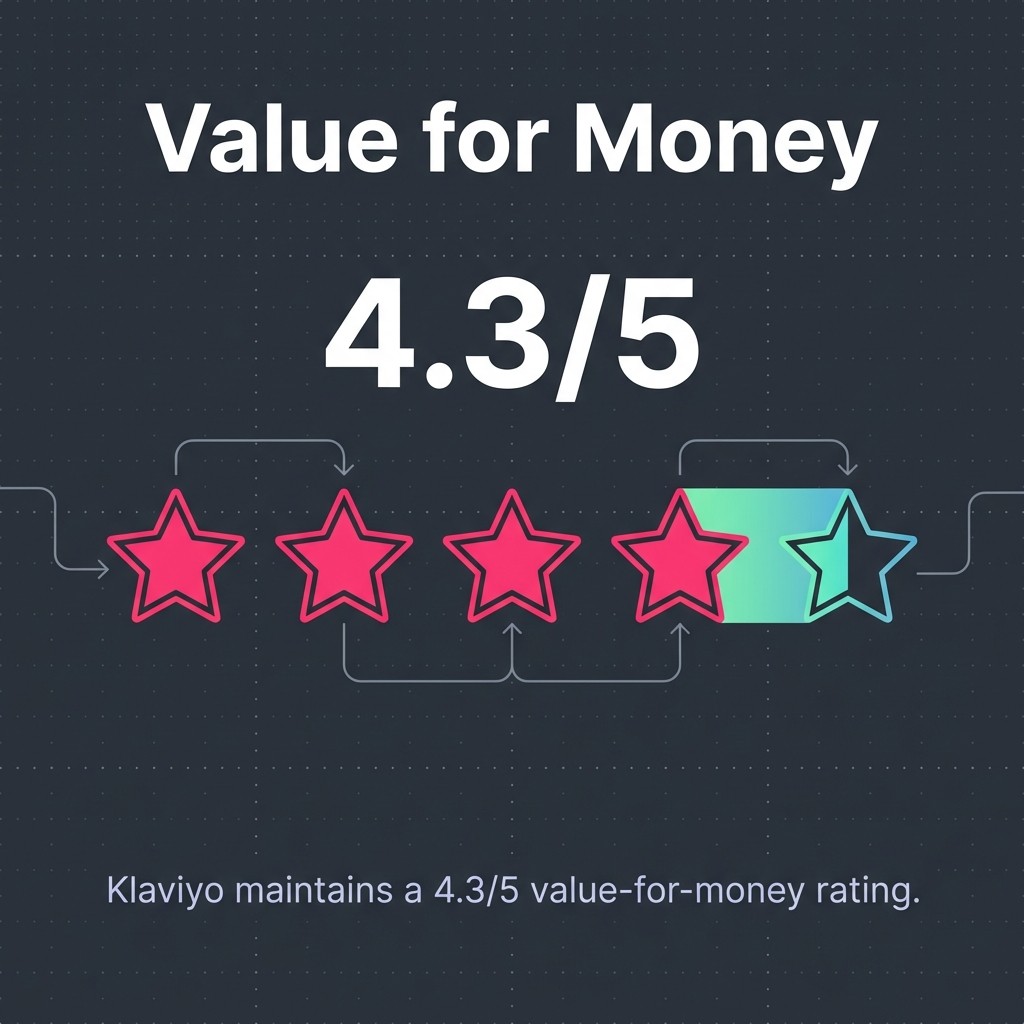
Klaviyo maintains a 4.3/5 value-for-money rating, suggesting most users find pricing justified by platform performance. But value only materialises through proper implementation.
Focus on high-impact flows first: welcome series, abandoned cart, post-purchase. These three flows typically generate 60-80% of email marketing revenue.
Immediate Actions to Justify Klaviyo Costs
Build a 3-email welcome series within your first week. Capture new subscriber emails and convert them to customers within 7-14 days of signup.
Set up abandoned cart recovery flows with 3-4 touchpoints over 72 hours. Email at 1 hour, 24 hours, and 48 hours post-abandonment. Add SMS at 4 hours for Email + SMS plans.
Implement a post-purchase flow requesting reviews and recommending related products. This drives repeat purchases within 30-45 days of first transaction.
Measuring Klaviyo's Revenue Impact
Track attributed revenue in Klaviyo's analytics dashboard. Most ecommerce brands should see 15-25% of total revenue attributed to email and SMS within 90 days.
Calculate cost per acquisition from Klaviyo flows. Divide monthly Klaviyo costs by new customers acquired through email marketing. Target £5-15 CPA for profitable scaling.
Monitor active profile growth versus revenue growth. If revenue scales faster than active profiles, your Klaviyo investment is delivering positive ROI.
Long-term Retention Strategy
Optimise flows quarterly based on performance data. A/B test subject lines, send timing, and content variations. Small improvements compound into significant revenue gains.
Expand beyond basic flows once foundations perform well. Add browse abandonment, win-back sequences, and VIP customer nurturing. These incremental flows drive additional 5-10% revenue.
Make retention inevitable by building a complete customer lifecycle email programme. Klaviyo pricing becomes irrelevant when flows consistently deliver 300-500% ROI monthly.
Final Thoughts on Klaviyo Pricing in 2026
Klaviyo's active profile billing makes costs predictable and scalable for ecommerce brands. You'll pay £20-100/month for most mid-market stores, with Email + SMS adding £15-30/month premium.
The February 2025 billing changes created short-term confusion but long-term clarity. Active profiles reward engagement, penalise poor list hygiene, and align costs with actual marketing performance.
Klaviyo sits at the premium end of email marketing pricing. That premium delivers value through ecommerce-specific features, advanced segmentation, and retention capabilities that directly impact revenue.
Start with the Email plan. Add SMS when you've proven email engagement and have a clear mobile marketing strategy. Monitor active profiles monthly and optimise flows quarterly.
The real cost isn't Klaviyo's monthly fee, it's the opportunity cost of poor retention. A well-optimised Klaviyo account should drive 20-30% of ecommerce revenue through email and SMS marketing.
Ready to make retention inevitable? Get a free Klaviyo audit and discover what your current Klaviyo strategy is actually costing you in lost revenue.
.jpg)
.jpg)