Klaviyo SMS Marketing: The Complete UK Compliance Guide
Klaviyo SMS lets you send targeted text messages that convert browsers into buyers and one-time customers into repeat purchasers. The platform handles two-way conversations, automated flows, and multilingual campaigns across multiple countries with built-in compliance management.
But here's what matters most for UK brands: you need explicit consent before sending that first text message. Miss this step and you're looking at regulatory trouble, not revenue growth.
This guide covers everything from setting up your first SMS campaign to navigating UK-specific compliance requirements. You'll learn which sending numbers work best, how to collect proper consent, and how to structure campaigns that drive results whilst keeping you compliant with PECR and GDPR.
By the end, you'll know exactly how to make SMS retention inevitable for your ecommerce store.
What Klaviyo SMS Marketing Delivers for UK Ecommerce Brands
Klaviyo SMS operates as part of a unified customer data platform. Your email data, purchase history, and browsing behaviour feed directly into your SMS campaigns.
This means you're not sending generic broadcasts. You're sending targeted messages based on actual customer behaviour.
Core SMS Capabilities That Drive Revenue
The platform includes automated flows triggered by customer actions. Someone abandons a cart, they receive a recovery text within minutes. A VIP customer hasn't purchased in 60 days, they get a win-back offer.
Two-way SMS conversations let customers reply directly. These responses sync with your help desk tools, so your support team can respond without switching platforms.
Personalised send times ensure messages arrive when each subscriber is most likely to engage. The system learns from past behaviour and adjusts delivery accordingly.
Integration with Your Existing Marketing Stack
Klaviyo SMS works alongside your email marketing, not as a separate channel. A customer who ignores an email gets an SMS follow-up. Someone who clicks your text receives a coordinated email sequence.
The platform connects with Shopify, WooCommerce, Magento, and other ecommerce platforms. Product data, inventory levels, and purchase history flow automatically into your SMS campaigns.
For UK brands managing customer lifecycles across multiple touchpoints, this integration makes retention strategy actually executable rather than theoretical.
Getting Started: SMS Setup in Klaviyo
Setting up SMS in Klaviyo requires three critical steps: choosing your sending number type, verifying your account, and collecting proper consent from subscribers.
Skip any of these and your campaigns won't send, or worse, they'll send without proper compliance measures in place.
Choosing Your Sending Number Type
Klaviyo offers three sending number options: toll-free numbers, short codes, and long codes. Each has distinct capabilities and compliance requirements.
Toll-free numbers work for most UK brands starting with SMS. They support two-way messaging, require minimal setup time, and handle moderate message volumes effectively.
Short codes deliver higher throughput and better brand recognition. SMS short code registration ensures compliance with CTIA audits with clear opt-out mechanisms, but the registration process takes several weeks.
Long codes function like standard mobile numbers. They're ideal for conversational messaging and customer service responses but have lower sending limits than other options.
Account Verification and Compliance Setup
Navigate to Settings, then SMS in your Klaviyo account. Select your country and request your preferred sending number type.

Klaviyo will verify your business information and intended use case. This verification protects against spam and ensures compliance with local regulations.
The approval process typically completes within 48 hours for toll-free numbers. Short codes require additional documentation and take 4-8 weeks to provision.
During setup, configure your opt-out keywords and compliance settings. These must be active before sending your first message.
Building Your SMS Subscriber List Properly
Explicit consent is required for SMS marketing, necessitating customers to agree to receive texts before the first message. This isn't optional under UK law.

Add SMS opt-in checkboxes to your checkout process, account creation forms, and email sign-up forms. Make the consent clear and separate from other permissions.
Your opt-in language must specify what subscribers will receive. "Get exclusive offers via text" is better than vague "Stay updated" messaging.
Document when and where each subscriber opted in. Klaviyo tracks this automatically, but understanding your consent sources helps optimise future list growth.
Understanding SMS Sending Numbers: Which Type Your Brand Needs
Your sending number type determines message deliverability, throughput, and how subscribers perceive your brand. Choose wrong and you'll face delivery issues or compliance problems.
Now that you understand the setup process, let's examine each sending number type in detail so you can select the right option for your specific needs.
Toll-Free Numbers: The Fastest Path to SMS Marketing
Toll-free numbers start with recognisable UK prefixes like 0800 or 0808. They support two-way conversations and handle moderate message volumes effectively.
Most UK ecommerce brands start here. Approval takes 48 hours, and you can begin sending immediately after verification.
Toll-free numbers work well for brands sending under 100,000 messages monthly. Beyond that volume, delivery speeds may slow during peak sending times.
The main limitation: some mobile carriers filter toll-free messages more aggressively than short codes. Monitor your delivery rates closely in the first 30 days.
Short Codes: Premium Sending for High-Volume Brands
Short codes are 5-6 digit numbers that deliver maximum throughput and brand recognition. They're what major retailers use for their SMS programmes.
These numbers handle hundreds of thousands of messages daily without slowdowns. They also enjoy better carrier relationships, which means higher delivery rates.
The trade-offs: short codes cost more to provision and maintain. Registration requires detailed documentation about your messaging programme and takes 4-8 weeks to complete.
Consider short codes if you're sending over 100,000 messages monthly or if SMS represents a core revenue channel for your brand.
Long Codes: Conversational Messaging at Scale
Long codes function like standard mobile numbers. They excel at one-to-one conversations and customer service interactions.
These work brilliantly for post-purchase support, order updates, and customer service responses. They feel personal because they look like regular phone numbers.
The constraint: long codes have strict throughput limits. Most carriers cap them at 1-2 messages per second, which makes them unsuitable for large broadcast campaigns.
Use long codes for transactional messages and support conversations, not promotional campaigns. For more guidance on optimising customer touchpoints across channels, see our results-focused Klaviyo strategy guide.
Branded Sender IDs: Not Available for Two-Way Messaging
Branded sender IDs display your company name instead of a number. They look professional but come with a critical limitation.
These IDs cannot receive inbound messages. Subscribers can't reply, which breaks two-way conversation capabilities and complicates opt-out management.
Most UK brands avoid branded sender IDs for this reason. The inability to handle responses creates compliance risks and poor customer experience.
UK SMS Compliance: PECR, GDPR, and Consent Requirements
UK SMS marketing falls under PECR (Privacy and Electronic Communications Regulations) and GDPR. Both require explicit consent before sending marketing messages.
Get this wrong and you face fines up to £17.5 million or 4% of annual turnover, whichever is higher. More immediately, you'll damage customer trust and deliverability.
What Explicit Consent Actually Means
Explicit consent means a clear affirmative action from the subscriber. Pre-ticked boxes don't count. Buried terms and conditions don't count.
Your opt-in must be separate from other consents. Don't bundle SMS permission with email sign-up or account creation unless each option can be selected independently.
The consent request must specify what subscribers will receive. State your message frequency, content type, and that standard message rates may apply.
Document everything. Record when consent was given, what language was used, and where the opt-in occurred. Klaviyo tracks this automatically when subscribers join through your forms.
Opt-Out Management and Response Times
Every SMS must include clear opt-out instructions. "Reply STOP to unsubscribe" is standard and effective.
Process opt-outs immediately. PECR doesn't specify an exact timeframe, but ICO guidance suggests acting within 24 hours at most.
Klaviyo handles this automatically when subscribers text STOP to your sending number. The system unsubscribes them and suppresses future sends without manual intervention.
Never require subscribers to visit a website or call a number to opt out. The process must be as simple as the original opt-in.
Quiet Hours and Message Frequency Caps
Avoid sending promotional texts between 21:00 and 08:00 UK time. Whilst not legally mandated, this practice prevents complaints and improves engagement.
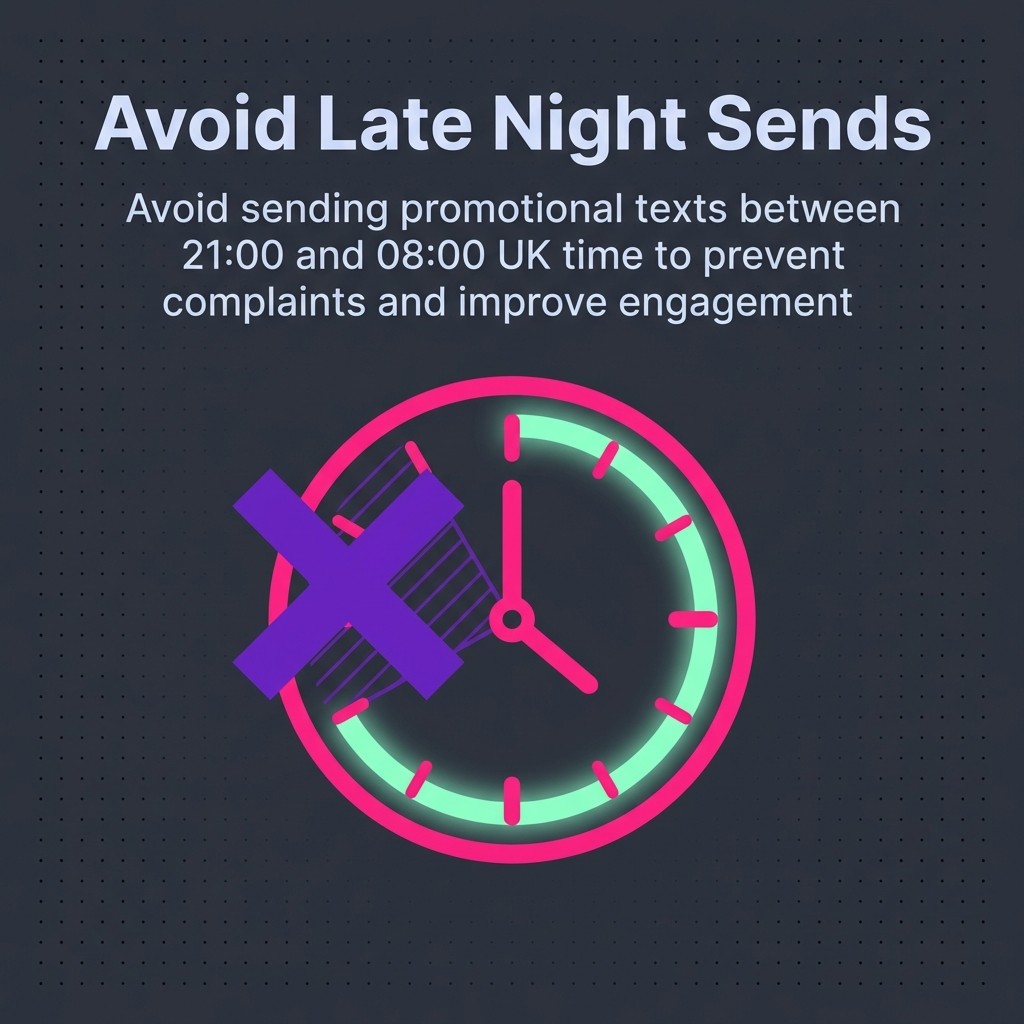
Klaviyo allows you to set sending windows by timezone. Configure these before launching your first campaign.
Message frequency matters too. Most successful SMS programmes send 2-4 promotional messages monthly, with additional transactional messages as needed.
Monitor your unsubscribe rate closely. If it spikes above 2-3% per campaign, you're sending too frequently or targeting poorly.
Transactional vs Promotional Message Distinction
Transactional messages don't require prior consent under PECR. These include order confirmations, delivery updates, and account security alerts.
Promotional messages require explicit opt-in. These include sales announcements, product recommendations, and marketing campaigns.
The line blurs when you include promotional content in transactional messages. A delivery confirmation with a product recommendation becomes promotional and requires consent.
Keep transactional messages purely informational. Save promotional content for subscribers who've specifically opted into marketing communications.
Klaviyo SMS Pricing: Credits, Costs, and Budget Planning
Klaviyo SMS pricing is contact-based with bundled credits. You pay for your contact list size, and SMS credits are included in your plan.

This differs from traditional SMS platforms that charge per message. Understanding the credit system helps you budget accurately and avoid unexpected costs.
How SMS Credits Work in Klaviyo
Each Klaviyo plan includes a specific number of SMS credits monthly. The exact allocation depends on your total contact count and plan tier.
One SMS credit typically equals one text message sent. MMS messages (which include images or video) consume more credits, usually 2-3 per message.
Credits reset monthly. Unused credits don't roll over, so plan your sending volume to use your allocation efficiently.
If you exceed your included credits, Klaviyo offers credit packs at fixed rates. Purchase these in advance to maintain sending capabilities.
Message Cost Variations by Country and Type
UK SMS messages cost less per credit than messages to other countries. International sending rates vary significantly by destination.
Standard SMS messages use one credit. MMS messages with images use 2-3 credits depending on file size and recipient carrier.
Inbound messages (subscriber replies) don't consume credits. This encourages two-way conversations without increasing costs.
Short code messages and toll-free messages cost the same per credit. Your sending number type doesn't affect the credit calculation, though provisioning fees differ.
Budgeting for SMS Marketing Success
Calculate your monthly sending needs before committing to a plan. Multiply your subscriber count by your intended message frequency.
A brand with 10,000 SMS subscribers sending 4 campaigns monthly needs approximately 40,000 credits, not accounting for automated flows.
Add 20-30% buffer for automated flows like abandoned cart recovery, browse abandonment, and post-purchase sequences. These fire based on customer behaviour, making volume harder to predict.
Monitor your credit usage weekly in your first 90 days. This reveals actual sending patterns and helps optimise your plan selection. Learn more about optimising your entire Klaviyo strategy for better outcomes in our comprehensive results-focused guide.
SMS Automation: Flows That Drive Repeat Purchases
SMS flows trigger automatically based on customer behaviour. Someone abandons a cart, they receive a recovery text. A first-time buyer completes checkout, they enter your post-purchase sequence.
These automated touchpoints generate revenue whilst you focus on strategy rather than manual campaign management.
Abandoned Cart SMS Recovery Sequences
Abandoned cart flows recover 15-30% of lost sales when properly configured. The key is timing and message content.

Send your first SMS 1-2 hours after abandonment. This catches customers still in buying mode without feeling pushy.
The message should be direct: "You left something behind. Complete your order now: [link]". Include product names if possible to create specificity.
Follow up 24 hours later if they haven't converted. This second message can include an incentive like free shipping or 10% off to overcome price objections.
Welcome Series for New SMS Subscribers
Your welcome flow sets expectations and drives early conversions. Send the first message immediately after opt-in whilst interest peaks.
Message one confirms their subscription and delivers the promised incentive. "Welcome! Here's your 15% off code: WELCOME15. Shop now: [link]".
Wait 3-5 days, then send message two introducing your bestsellers or brand story. This builds relationship beyond the initial discount.
Message three arrives after 7-10 days with social proof or urgency. "Join 10,000+ happy customers. Limited stock on bestsellers: [link]".
Post-Purchase Sequences That Build Loyalty
Post-purchase flows increase repeat purchase rates by staying relevant after the first sale. Timing matters more than message count.
Send a delivery confirmation when the order ships. Include tracking information and estimated arrival time.
Follow up 3-5 days after delivery asking for feedback or a review. "How's your [product name]? Share your thoughts: [link]".
After 30 days, recommend complementary products based on their purchase. "Loving your [product]? Customers also bought: [products]".
For consumable products, trigger reorder reminders based on expected usage. "Running low on [product]? Reorder now and save 10%: [link]". For more insights on building effective customer lifecycle flows, see our guide on Klaviyo re-entry criteria and flow optimisation.
Win-Back Campaigns for Lapsed Customers
Win-back flows target customers who haven't purchased in 60-90 days. These recover revenue from your existing database.
The first message acknowledges their absence. "We miss you! Here's 20% off your next order: [code]".
If they don't respond within a week, send a second message highlighting new products or bestsellers they haven't seen.
The final message in the sequence should create urgency. "Last chance: Your 20% off expires tonight. Shop now: [link]".
SMS and MMS: Choosing the Right Message Type
SMS delivers plain text up to 160 characters. MMS supports images, video, and longer content but costs 2-3x more per message.
The decision isn't always obvious. Sometimes a simple text outperforms a rich media message despite lower production value.
When Plain SMS Outperforms MMS
SMS works brilliantly for time-sensitive offers, abandoned cart reminders, and reorder notifications. The simplicity drives immediate action.
Plain text feels more personal, especially for conversational messages or customer service responses. It mimics how people actually text each other.
SMS also delivers faster. No images to load means instant display, which matters for flash sales or limited inventory situations.
The 160-character limit forces clarity. You can't bury the offer in paragraph three. The message gets straight to the point.
Leveraging MMS for Visual Impact
MMS excels when the product is highly visual. Fashion, home decor, and food brands benefit from showing rather than describing.
Use MMS for new product launches where the visual tells the story. A single image of your new collection generates more interest than text descriptions.
MMS also works well for tutorials or how-to content. A short video showing product usage provides more value than text instructions.
The higher cost per message means MMS should target your most engaged segments. Save it for VIP customers and proven converters.
Testing SMS vs MMS Performance
Split test message types on the same offer to your most engaged segment. Send half plain SMS, half MMS with product image.
Track click-through rates and conversion rates separately. Sometimes the cheaper SMS option converts better despite less visual appeal.
Consider loading times too. Subscribers on slower connections may abandon MMS messages before images load completely.
Run tests for 7-14 days to gather meaningful data. Weekend vs weekday performance often differs significantly for both message types.
Segmentation and Personalisation for Higher SMS Engagement
Generic broadcasts to your entire SMS list waste credits and increase unsubscribes. Segmentation lets you send relevant messages to specific customer groups.
Klaviyo's customer data platform makes this possible without complex list management. Your segments update automatically as customer behaviour changes.
Behavioural Segmentation Strategies
Segment by purchase history first. Customers who've bought once need different messages than customers who've bought five times.
Create segments for product categories. Someone who buys skincare products receives different recommendations than someone who buys supplements.
Engagement level matters too. Subscribers who click every message deserve more frequent sends than subscribers who rarely engage.
Browse behaviour creates powerful segments. Target people who viewed specific products but didn't purchase with personalised recommendations.
Lifecycle Stage Segmentation
New subscribers need welcome sequences and education. Active customers need new products and loyalty rewards. Lapsed customers need win-back campaigns.
Define your lifecycle stages based on purchase frequency. A "lapsed" customer for a daily consumable differs from one for luxury goods.
Tag customers by their stage automatically using Klaviyo's conditional splits. This ensures everyone receives contextually relevant messages.
Move customers between stages based on behaviour. A lapsed customer who makes a purchase immediately re-enters your active customer flow.
Personalisation Beyond First Names
First name personalisation is baseline. Go further by including product names, purchase dates, and specific recommendations.
"Your [product name] order shipped today" beats "Your order shipped today". The specificity confirms relevance.
Reference past purchases in recommendations. "Since you loved [product], try [complementary product]" creates logical connections.
Use location data for store-specific offers if you have retail locations. "Visit our Manchester store this weekend for exclusive offers".
AI-Powered SMS Features in Klaviyo
Klaviyo's AI capabilities optimise send times, predict customer behaviour, and personalise content at scale. These features work automatically once enabled.
The system learns from your specific customer data, not generic industry benchmarks. This means recommendations improve over time as your database grows.
Predictive Analytics for Better Targeting
Predictive analytics identify customers likely to make their next purchase soon. Target these high-intent subscribers with relevant offers.
The system also flags customers at risk of churning. Send win-back campaigns before they fully disengage rather than after.
Expected date of next order predictions help time your reorder reminders perfectly. Too early and you're pushy. Too late and they've bought elsewhere.
Customer lifetime value predictions let you segment by future value, not just past purchases. Invest more in high-potential customers even if they've only bought once.
Smart Send Time Optimisation
Send time optimisation delivers messages when each subscriber is most likely to engage. The system analyses past behaviour to predict optimal timing.
This happens automatically for subscribers with sufficient engagement history. New subscribers receive messages at your default send time until the AI gathers data.
The improvement typically adds 5-15% to open rates without changing message content. Better timing means more subscribers see your message when they're receptive.
Enable this feature at the flow level or campaign level. It works for both promotional campaigns and automated sequences.
Content Recommendations Based on Behaviour
AI-powered product recommendations analyse purchase patterns across your entire customer base. The system identifies products frequently bought together.
These recommendations appear in your SMS messages automatically when enabled. The content adapts to each recipient based on their specific history.
Someone who bought running shoes sees running apparel. Someone who bought supplements sees complementary health products.
The recommendations improve as more customers purchase. Each transaction trains the model to make better predictions for future subscribers.
SMS Analytics: Measuring What Actually Matters
SMS analytics in Klaviyo track delivery rates, click-through rates, conversion rates, and revenue per message. These metrics reveal what's working and what's wasting credits.
Focus on revenue metrics first. High open rates mean nothing if messages don't drive purchases.
Key Performance Indicators for SMS Success
Delivery rate shows what percentage of messages reached subscribers. Aim for 95%+ delivery. Lower rates suggest number reputation issues or list quality problems.
Click-through rate measures how many subscribers clicked your link. Strong SMS campaigns achieve 15-25% CTR, significantly higher than email.
Conversion rate tracks purchases from SMS clicks. This varies by offer type but typically ranges from 3-8% for promotional campaigns.
Revenue per recipient shows the actual value generated. This metric matters most because it accounts for the entire customer journey from click to purchase.
Comparing SMS to Email Performance
SMS typically delivers 5-8x higher open rates than email but reaches a smaller audience. Not everyone opts into SMS marketing.
Click-through rates for SMS often double email performance. The immediacy and personal nature of texts drive faster action.
Cost per conversion differs significantly. SMS costs more per message but often converts at higher rates, making the actual cost per sale comparable.
Use SMS for time-sensitive offers and high-intent segments. Use email for educational content and broader audience reach.
Attribution and Multi-Touch Analysis
Many customers interact with multiple channels before purchasing. Your SMS might be the final touchpoint, but email introduced the product.
Klaviyo's attribution reports show the full customer journey. See which channels contribute to conversions even if they weren't the last click.
This prevents over-crediting or under-crediting specific channels. SMS might appear less effective in last-click attribution but crucial in multi-touch analysis.
Review attribution reports monthly to understand how SMS fits your overall retention strategy. Adjust your channel mix based on actual contribution to revenue.
Integrating SMS with Your Omnichannel Strategy
SMS works best alongside email, not as a replacement. The two channels complement each other when coordinated properly.
Customers who engage with both SMS and email spend 20-40% more than single-channel subscribers. The key is coordination, not duplication.

Cross-Channel Campaign Coordination
Send email first for product launches or major announcements. Follow up with SMS to subscribers who didn't open the email within 24 hours.
This two-channel approach catches people who missed your email without annoying those who already engaged.
For flash sales, reverse the order. SMS creates immediate urgency, email provides detailed information and product browsing.
Coordinate your messaging so each channel reinforces the other. Don't repeat the exact same message, provide complementary information.
Progressive Profiling Across Channels
Collect different information through each channel. Email captures detailed preferences, SMS confirms immediate interests.
Use SMS responses to update customer profiles. Someone who replies "YES" to a product category question gets tagged automatically.
This progressive approach builds comprehensive customer profiles without overwhelming subscribers with long forms.
The richer your data, the better your segmentation. Better segmentation drives higher relevance and improved results across all channels.
Channel Preference Management
Let customers choose their preferred channel. Some prefer email, others want SMS only, many want both for different purposes.
Add a preference centre where subscribers select which message types they receive on each channel.
Respect these preferences strictly. Ignoring stated preferences increases unsubscribes and damages trust.
Review preference data quarterly. Patterns reveal which content types work best on each channel for your specific audience.
Countries Where Klaviyo SMS is Available
Klaviyo SMS operates in countries where toll-free numbers, short codes, or long codes support two-way messaging. Geographic availability expands regularly as new regions gain proper SMS infrastructure.
The platform currently serves brands across North America, Europe, and Australia. Specific country availability depends on local regulations and carrier relationships.
UK and European SMS Availability
UK brands can use Klaviyo SMS with toll-free numbers or long codes. The platform handles PECR compliance automatically when you configure consent settings properly.
Several European countries support Klaviyo SMS, though availability varies by region. Check your specific country in the Klaviyo setup wizard under Settings → SMS.
European SMS regulations differ by country. GDPR provides the baseline framework, but individual nations add specific requirements around consent and opt-out management.
Branded sender IDs work in many European countries but lack two-way capabilities. This limits their usefulness for retention marketing where customer responses matter.
North American SMS Coverage
United States and Canada enjoy full Klaviyo SMS support across all sending number types. Short codes, toll-free numbers, and long codes all function properly.
US regulations under TCPA require explicit written consent. Klaviyo's consent management tools handle this automatically when configured during setup.
Canadian CASL regulations are similarly strict. The platform enforces consent requirements and manages opt-outs to maintain compliance.
Cross-border messaging between US and Canada works seamlessly. One sending number can reach subscribers in both countries without separate setup.
Other Supported Regions
Australia supports Klaviyo SMS with full two-way messaging capabilities. The Spam Act 2003 governs consent requirements, which Klaviyo manages through its compliance tools.
New regions get added regularly as local SMS infrastructure develops. Check Klaviyo's official documentation for the most current country availability.
If your target country isn't listed, contact Klaviyo support. They often have beta programmes for new regions before official launch.
Common SMS Marketing Mistakes UK Brands Make
Most SMS failures stem from treating texts like emails. The medium demands different strategy, timing, and message structure.
These mistakes waste credits, increase unsubscribes, and damage deliverability. Avoid them and your SMS programme performs significantly better.
Sending Too Frequently Without Segmentation
Broadcasting to your entire list weekly burns through goodwill fast. Subscribers expect relevance, not repetition.
Segment by engagement level and adjust frequency accordingly. Your most engaged subscribers can handle 2-3 messages weekly. Casual subscribers need 2-4 monthly at most.
Monitor unsubscribe rates per campaign. Spikes above 2% signal frequency or relevance problems.
Let subscribers control frequency through preference centres. Self-selection prevents over-sending to sensitive contacts. For strategic insights on avoiding common flow mistakes, read our guide on Klaviyo flows that ecommerce stores actually need.
Neglecting Proper Consent Collection
Adding customers to SMS lists without explicit consent violates PECR. Purchased lists, scraped numbers, and assumed consent all create regulatory risk.
Every subscriber needs documented opt-in. Pre-ticked checkboxes don't satisfy legal requirements.
Your consent language must be specific. "Get updates" is too vague. "Receive promotional texts about sales and new products" provides proper clarity.
Audit your consent collection process quarterly. Ensure all entry points capture proper documentation.
Writing SMS Like Email
Long paragraphs don't work in SMS. Get to the point in the first line, include your link, and end with a clear call to action.
Your message competes with personal texts from friends and family. Match that conversational tone rather than corporate marketing speak.
Avoid multiple links per message. One clear action drives better results than three competing options.
Test your messages on actual devices before sending. What looks good in Klaviyo's composer might display poorly on various phones.
Ignoring Analytics and Testing
Sending the same message types repeatedly without testing leaves money on the table. Small improvements compound over time.
Test send times first. A message at 10am might perform 30% better than one at 6pm for your specific audience.
Test offer structures. Free shipping might convert better than percentage discounts, or vice versa.
Test message length. Sometimes 60 characters outperforms 150 characters despite saying less.
Run one test per week. After 12 weeks you'll have transformed your SMS performance through accumulated improvements.
Quick Answers to Common Klaviyo SMS Questions
Does Klaviyo offer SMS?
Yes, Klaviyo offers SMS and MMS messaging as core features of its marketing platform. The service includes two-way SMS conversations, automated workflows, multilingual campaigns, and compliance management across multiple countries with real-time syncing capabilities.
Which countries is Klaviyo SMS available in?
Klaviyo SMS operates in countries where toll-free numbers, short codes, or long codes support two-way messaging. The platform serves brands across North America, Europe, and Australia, though specific availability varies by region and sending number type.
What's the difference between SMS and MMS in Klaviyo?
SMS delivers plain text up to 160 characters and costs one credit per message. MMS supports images, video, and longer content but consumes 2-3 credits per message depending on file size and recipient carrier.
Make SMS Retention Inevitable for Your Ecommerce Brand
Klaviyo SMS transforms browsers into buyers and one-time customers into repeat purchasers when you implement it properly. The platform handles compliance, manages consent, and coordinates with your email marketing automatically.
Start with proper consent collection and sending number selection. These foundational elements determine everything that follows.
Build your abandoned cart and welcome flows first. These two sequences generate immediate revenue whilst you develop more sophisticated automation.
Test relentlessly. Small improvements in timing, message structure, and offer presentation compound into significant revenue gains over 90 days.
SMS marketing isn't complicated, but it requires attention to compliance details and strategic thinking about customer lifecycles. Get both right and you'll see measurable impact within your first month.
Ready to make retention inevitable? Start by setting up your first Klaviyo SMS flow today. Your customers are waiting to hear from you.
.jpg)
.jpg)