Post-Purchase Email Flow: Boost Repeat Orders
Most ecommerce brands focus their email budget on customer acquisition, yet the period immediately after someone buys is when your retention potential peaks. A strategically built post-purchase email flow can turn first-time buyers into repeat customers whilst they're still excited about their purchase.
The data backs this up. Shipping confirmations average 62.99% open rates compared to typical promotional emails at 30-31%. That's double the engagement in a window most brands waste on generic "thanks for your order" messages.

Here's what separates brands that build loyalty from those that chase one-time sales. The post-purchase journey isn't about closing the transaction. It's about opening the relationship. Your customer just demonstrated trust by handing over their money. What you do in the next seven days determines whether they come back or disappear into your database.
This guide covers how to build post-purchase flows that drive repeat orders. You'll get specific email types, timing strategies, and personalisation tactics that make retention inevitable.
What Post-Purchase Emails Actually Do for Your Brand
Post-purchase emails are automated messages triggered by a customer completing a purchase. They serve dual purposes: confirming transactional details and building the relationship that drives future revenue.
The transactional function is straightforward. Customers need order confirmations, shipping updates, and delivery notifications. These are table stakes for ecommerce. You send them, customers expect them, everyone moves on.
The retention function is where most brands miss the opportunity.
Every post-purchase email is a touchpoint in your customer lifecycle. Done properly, these messages educate customers about your product, collect feedback that improves your offering, and position your brand as a trusted partner rather than a transaction processor.
Think about your own buying behaviour. The brands you return to aren't just those with good products. They're the ones that made you feel confident about your purchase, helped you use what you bought, and stayed present without being pushy.
That's what a well-designed post-purchase flow delivers. It transforms the post-purchase period from an administrative necessity into a strategic retention asset.
Why Post-Purchase Flows Matter More Than Welcome Sequences
Welcome sequences get all the attention in email marketing guides. Post-purchase flows drive more revenue per subscriber.
Here's why. Someone joining your list is expressing interest. Someone completing a purchase is demonstrating intent. The person who just bought has already overcome every objection that stops most visitors from converting.
They trust your brand enough to spend money. They've experienced your checkout process and didn't abandon. They're expecting to hear from you about their order, which means every email you send has built-in permission and attention.
This window of elevated engagement is finite. Most brands squander it with purely transactional messages that treat customers like order numbers rather than people building a relationship with your brand.
Customer Lifetime Value Starts Here
Your customer lifetime value isn't determined by first purchase size. It's determined by whether someone buys a second time.
The economics of customer retention show that second purchases are significantly more profitable than first purchases. You've already absorbed the acquisition cost. Every subsequent purchase is higher-margin revenue.
Post-purchase flows are where you earn that second purchase. The emails you send in the first 30 days after someone buys determine whether they mentally categorise your brand as "that place I tried once" or "my go-to for this product category".
The Retention Compound Effect
Customer loyalty doesn't happen in isolation. It compounds.
A customer who makes a second purchase is significantly more likely to make a third. Someone who buys three times has dramatically higher lifetime value than someone who buys twice. Each purchase increases the probability of the next one.
Post-purchase flows initiate this compound effect. They move customers from "tried your brand" to "trust your brand". That shift in mindset is what separates transactional customers from loyal ones.
Post-Purchase Email Performance Benchmarks
Before building your flow, you need context for what good performance looks like. Post-purchase emails operate in a different engagement environment than standard promotional campaigns.
Here's what the data shows about post-purchase email performance.
Email TypeAverage Open RatePurposeOrder Confirmation60-70%Transaction verification and reassuranceShipping Confirmation62.99%Status update and tracking detailsStandard Promotional30-31%Product promotion and sales
The open rate difference between transactional post-purchase emails and promotional campaigns tells you everything about customer attention. People are highly engaged with messages about orders they just placed.
That engagement creates opportunity. The question is whether you're using it to build relationships or just fulfilling administrative requirements.
Why Segmentation Multiplies Results
Generic post-purchase emails waste your highest-engagement window. Segmented emails drive 30% more opens than unsegmented ones.

Apply that to post-purchase flows and you're looking at 80%+ open rates on properly segmented order confirmations. That's not theoretical. That's what happens when you personalise based on what someone actually bought.
Most ecommerce brands send identical post-purchase sequences regardless of product purchased, order value, or customer type. They're leaving revenue on the table by treating all purchases identically.
How to Segment Your Post-Purchase Strategy
Effective segmentation starts with recognising that not all purchases are equal. Someone buying a £500 product needs different follow-up than someone spending £25. A first-time customer requires different communication than a returning buyer.
Here's how to structure your segmentation for maximum retention impact.
Product Category Segmentation
Different products require different post-purchase journeys. A consumable product that runs out needs replenishment reminders. A durable good needs usage education and complementary product suggestions.
Build separate post-purchase flows for distinct product categories. Your supplement customers need different emails than your furniture customers. This seems obvious, yet most brands use a single generic flow for all purchases.
Start by identifying your 3-5 main product categories. Build dedicated flows for each. If you sell both clothing and home goods, those customers have completely different needs in the post-purchase period.
Order Value Segmentation
High-value customers deserve high-touch follow-up. Someone spending £300 on their first purchase has different expectations than someone spending £30.
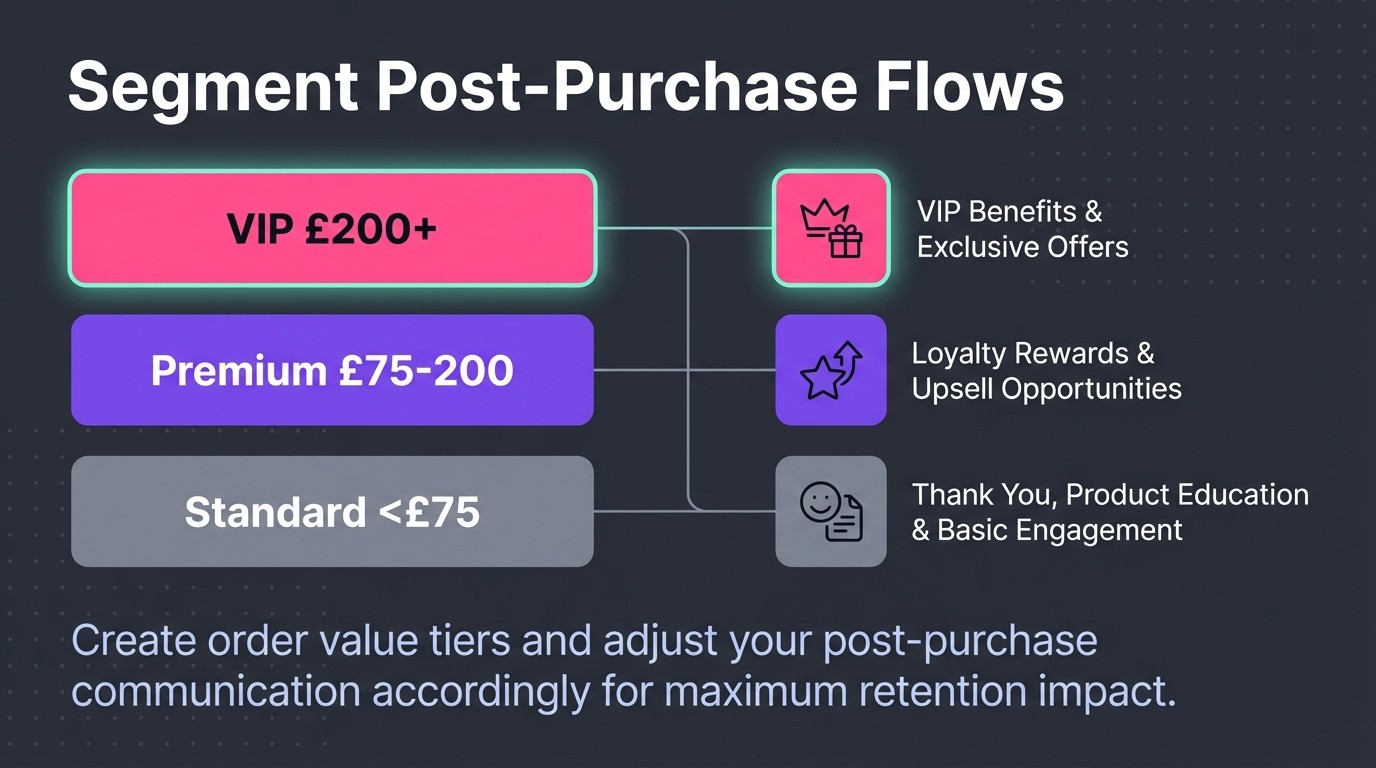
Create order value tiers and adjust your post-purchase communication accordingly. Your thresholds will depend on your average order value, but a typical structure might look like:
- Standard tier: Under £75 - Automated flow with standard touchpoints
- Premium tier: £75-£200 - Enhanced content with product education
- VIP tier: Over £200 - Personalised follow-up with priority support access
The content doesn't need to be dramatically different. The attention level should be.
Customer Type Segmentation
First-time customers need relationship building. Repeat customers need loyalty reinforcement. These require different messaging strategies.
Your first-time buyer flow should focus on brand education, setting expectations, and creating confidence in their purchase decision. Your repeat customer flow should acknowledge their loyalty, offer exclusive perks, and reinforce their smart decision to come back.
This segmentation requires tracking purchase history. Most email automation platforms, including Klaviyo, make this straightforward with conditional splits based on profile properties.
Order Confirmation Emails That Build Trust
Your order confirmation email arrives within seconds of purchase. It's the highest-attention message in your entire customer lifecycle. Open rates consistently exceed 60%, often reaching 70-80% for well-designed confirmations.

Most brands use this premium real estate to simply list what someone bought. That's necessary, but insufficient.
Here's what a strategic order confirmation includes.
Essential Transactional Elements
The foundation is non-negotiable. Your confirmation must include:
- Clear order number prominently displayed
- Complete itemised purchase list with product images
- Total amount charged with payment method confirmation
- Shipping address verification
- Expected delivery timeframe
- Direct link to order tracking page
- Customer support contact details
These elements serve anxiety reduction. Someone just gave you money online. They need immediate reassurance that the transaction completed correctly and their purchase is on the way.
Strategic Relationship Elements
Once you've handled the transactional basics, use remaining attention for relationship building.
Add a genuine thank you that references their specific purchase. "Thanks for ordering" is generic. "Thanks for choosing our organic cotton bedding" is personal.
Include what happens next with specific timing. "You'll receive shipping confirmation within 24 hours" sets clear expectations. Uncertainty creates support tickets and erodes trust.
Set up their account if they checked out as a guest. Make it frictionless by pre-filling their information and sending a one-click account activation link.
Product Education Preview
Reference what they bought and preview the value they'll receive. If they purchased skincare, mention the results they can expect with consistent use. If they bought kitchen equipment, reference the recipes they can now make.
This isn't upselling. It's value reinforcement. You're reminding them why they bought and building excitement for product arrival.
Mobile Optimisation Priority
Over 60% of order confirmations are opened on mobile devices. Your design must work perfectly on small screens.
Use single-column layouts. Make buttons large and tappable. Keep key information above the fold. Test your confirmation on actual mobile devices, not just responsive preview tools.
A confirmation that's difficult to read on mobile creates immediate friction with your brand. Someone should be able to verify their order in under 10 seconds whilst standing in a queue.
Shipping and Delivery Notification Strategy
Shipping confirmations are your second-highest engagement opportunity in the post-purchase flow. They average 62.99% open rates because customers actively want this information.
The basic function is simple: Tell people their order shipped and provide tracking details. The strategic function is continuing the relationship whilst customers are paying attention.
Immediate Shipping Confirmation
Send shipping confirmation the moment your fulfilment system generates tracking information. Speed matters here. Someone checking their email 30 minutes after placing an order should see shipping confirmation if you've already processed it.
Include the tracking number prominently. Link directly to the carrier's tracking page. If you use multiple carriers, make sure the link goes to the correct carrier automatically.
Add expected delivery date in clear, specific language. "Your order will arrive Tuesday, 4th March" beats "Estimated delivery in 3-5 business days".
Delivery Confirmation and Usage Guidance
Once the package reaches the customer, send delivery confirmation within 24 hours. This email serves multiple purposes beyond status update.
Confirm the delivery and ask them to verify receipt. This catches delivery issues early and shows you care about their experience.
Include quick start guidance for the product they purchased. Link to setup instructions, care guides, or usage videos. Make the first interaction with your product smooth and successful.
This is where you can introduce complementary products naturally. Someone who just received running shoes might appreciate a link to your sock collection. Make it helpful, not pushy.
Tracking Update Frequency
Don't bombard customers with updates at every shipping milestone. Most people don't need to know their package reached the regional distribution centre at 3am.
Send updates at meaningful moments:
- Order confirmed and processing
- Shipped with tracking information
- Out for delivery (optional, based on carrier capabilities)
- Delivered confirmation
Each email should add value or serve a clear functional purpose. Updates for the sake of staying in the inbox create fatigue rather than engagement.
Thank You Emails That Strengthen Customer Loyalty
Thank you emails occupy a strange space in post-purchase flows. Done poorly, they're redundant fluff that states the obvious. Done properly, they build emotional connection that transcends transactional relationships.
The key is making thanks meaningful rather than perfunctory.
When to Send Thank You Messages
Timing determines impact. Send thank you emails 24-48 hours after delivery confirmation. This gives customers time to receive and ideally use what they purchased.
Don't send thank you messages before customers receive their order. Thanking someone before they've experienced your product feels premature and potentially jinxed if delivery goes wrong.
Making Gratitude Specific
Generic thanks is forgettable. "Thank you for your purchase" could come from any brand. Reference what they specifically bought and why it matters.
"Thanks for trusting us with your bedroom refresh" acknowledges the bedding purchase and recognises the larger goal driving it. This shows you understand their purchase in context, not just as a transaction.
Include founder notes for VIP customers. A brief personal message from your founder or CEO elevates high-value purchases from transactional to relationship-based.
Adding Unexpected Value
The best thank you emails include something unexpected. This could be:
- Early access to new products
- Discount code for their next purchase (with reasonable expiry)
- Free digital content related to their purchase
- Invitation to a customer-only community
- Behind-the-scenes content about how their product is made
The value doesn't need to be monetary. Exclusivity and insider access often create more loyalty than discounts.
Encouraging Reciprocal Action
After demonstrating appreciation, invite engagement. This might be asking customers to share their purchase on social media, join your community, or simply reply with feedback about their experience.
Keep the ask proportional to the relationship stage. Don't demand five-star reviews from first-time customers. Build to bigger asks as the relationship develops.
Review Request Timing and Best Practices
Review requests are where most brands get post-purchase email timing completely wrong. They either ask too early, before customers have used the product, or too late, after the experience has faded from memory.
Getting this right requires understanding product usage timelines.
Optimal Review Request Timing
The universal rule is: Request reviews after customers have had sufficient time to form an opinion, but before the purchase becomes distant memory.
For physical products, wait at least 7-14 days after delivery. Someone who received a skincare product yesterday can't meaningfully review effectiveness. Someone who received it three weeks ago can discuss results and experience.
For consumables, align requests with expected usage patterns. Coffee subscriptions might request reviews after the first bag is likely finished. Supplements might wait 30 days to request feedback on results.
Referral requests perform best within 24-48 hours of purchase, but review requests need product experience first. Don't confuse the two.

Making Reviews Easy to Submit
Every obstacle between request and submitted review reduces completion rates. Optimise your review request emails for maximum simplicity.
Include a one-click link directly to the review form for their specific product. Don't make customers navigate to your reviews page and search for what they bought.
Pre-fill customer information from your system. Name, email, and purchase verification should already be populated when they land on the review form.
Provide rating scale guidance. Instead of assuming everyone knows what five stars means, explicitly state your criteria: "5 stars: Exceeded expectations, 4 stars: Met expectations" etc.
Incentivising Reviews Without Bias
Offering incentives for reviews is acceptable. Offering incentives only for positive reviews is not.
Frame incentives neutrally. "Share your honest feedback and receive 10% off your next order" works. "Leave a five-star review for a discount" violates most review platform policies and erodes trust.
The best incentive is making customers feel heard. Many people leave reviews simply because they want to help other buyers or improve the product. Acknowledge this motivation explicitly in your request.
Following Up on Negative Reviews
Monitor review submissions and trigger immediate follow-up for low ratings. A customer who leaves three stars or below is signalling dissatisfaction that requires attention.
Send personalised outreach within 24 hours. Acknowledge their experience, apologise for falling short, and offer concrete resolution. This won't always save the relationship, but it significantly increases the chances.
Sometimes the best outcome from a negative review is preventing that customer from becoming a vocal critic. Fast, genuine response turns potential brand enemies into neutral parties, and occasionally into advocates who update reviews after good service recovery.
Product Recommendations and Cross-Sell Strategy
Cross-sell emails in post-purchase flows generate revenue whilst customers are still in buying mode. The key is relevance and timing, not aggressive selling.
Done properly, product recommendations feel like helpful suggestions. Done poorly, they feel like you're exploiting the transaction for more sales.
Building Recommendation Logic
Your cross-sell suggestions should be based on actual purchase relationships, not random product displays. Use three recommendation strategies:
Complementary products that enhance what they bought. Someone purchasing a coffee machine should see coffee beans, grinders, or milk frothers. These are natural pairings that improve their original purchase experience.
Frequently bought together combinations from your data. Analyse purchase patterns to identify products that customers typically buy in sequence. This requires sufficient transaction history but creates highly relevant suggestions.
Category expansion that introduces customers to related product lines. Someone buying skincare might be interested in your haircare range. Keep these suggestions aligned with demonstrated interests.
Timing Your Cross-Sell Emails
Send your first product recommendation email 5-7 days after delivery. This gives customers time to experience their purchase and mentally close that buying decision before considering the next one.
Subsequent recommendations can follow 14-30 days later, depending on product category and purchase frequency. Space suggestions to avoid overwhelming customers with constant selling.
Personalisation Beyond Product
Personalise recommendations based on purchase behaviour and value signals, not just what they bought.
High-value customers should see premium product suggestions. Discount-sensitive buyers should see entry-level options. First-time purchasers need different recommendations than loyal repeat customers.
Reference their previous purchase in recommendation emails. "Since you loved our organic cotton sheets, you might appreciate our matching duvet covers" connects the suggestion to demonstrated preference.
The Soft Sell Approach
Frame recommendations as helpful suggestions rather than sales pitches. Your tone should prioritise customer benefit over your revenue goals.
"These products work brilliantly with what you purchased" beats "Complete your order with these items". One feels like advice from a knowledgeable friend. The other feels like a checkout upsell.
Include educational content with recommendations. Explain why certain products pair well together or how customers typically use them in combination. This adds value beyond simple product links.
Building Lifecycle Flows for Long-Term Retention
Post-purchase emails extend beyond the immediate days after a transaction. The strongest retention strategies build comprehensive lifecycle flows that nurture customers across their entire relationship with your brand.
This requires thinking beyond individual purchases towards the complete customer journey.
Replenishment Reminders for Consumables
If you sell products that run out, replenishment emails are your highest-ROI retention tactic. Someone who successfully used your product once is highly likely to buy again when they need more.
Calculate average usage periods based on product size and typical consumption rates. A 30-day supply should trigger a replenishment email around day 25. This catches customers before they run out and consider competitors.
Make reordering frictionless with direct add-to-cart links. Better yet, use Klaviyo's API capabilities to pre-populate orders that customers can confirm with a single click.
Reference their previous purchase specifically. "Ready for more of the Kenya AA coffee you ordered last month?" beats generic "Time to reorder" messaging.
Win-Back Campaigns for Lapsed Customers
Every customer who doesn't make a second purchase represents failed retention. Win-back campaigns try to recover these customers before they're permanently lost.
Trigger win-back flows based on expected purchase frequency. If your average customer reorders every 60 days, send your first win-back email at day 75. This catches declining engagement before it becomes total disengagement.
Address the gap directly. "We noticed it's been a while since your last order" acknowledges the lapse without being pushy. Combine this with a compelling reason to return, whether that's new products, improved offerings, or limited incentives.
Make win-back offers meaningful. A 5% discount won't convince someone who's mentally moved on. Consider more substantial incentives: 20% off, free shipping, or bonus products with purchase.
Loyalty Programme Integration
Post-purchase flows should connect to broader loyalty programmes. Every purchase is an opportunity to recognise progress towards rewards and encourage continued engagement.
Include loyalty status updates in your confirmation emails. "This purchase earned you 250 points. You're now 150 points from Gold status" creates tangible progress visibility.
Send dedicated loyalty milestone emails when customers reach new tiers. These moments deserve celebration and recognition that reinforces their decision to remain loyal.
Exclusive loyalty perks should appear in post-purchase communications. Early access to sales, special product launches, or enhanced support options reward loyalty whilst encouraging continued purchases.
Email Automation and Technical Implementation
Strategic planning means nothing if your technical implementation fails. Post-purchase flows require reliable automation infrastructure that triggers correctly and personalises effectively.
Here's what proper implementation looks like.
Choosing Trigger Events
Post-purchase flows should use behavioral triggers rather than time-based sending. Behaviour indicates intent and readiness. Time is arbitrary.
Your core triggers include:
- Order placed (for confirmation)
- Order fulfilled (for shipping notification)
- Order delivered (for delivery confirmation and next steps)
- Product review submitted (for thank you and reward)
- Expected reorder date approaching (for replenishment)
Build conditional logic that adjusts flows based on customer properties. First-time buyers get different sequences than repeat customers. High-value orders trigger different touchpoints than standard purchases.
Setting Up Flow Architecture
Structure your flows with clear entry criteria and exit conditions. Someone should only be in one post-purchase flow at a time, preventing overlap that creates message fatigue.
Use proper re-entry criteria to allow customers to enter flows multiple times for different purchases. Your order confirmation flow should trigger for every purchase, not just the first one.
Build timing delays based on typical customer behaviour, not arbitrary intervals. If 80% of orders deliver within three days, schedule your post-delivery email for day four.
Personalisation Token Setup
Effective personalisation requires proper data structure. Your ecommerce platform must pass detailed purchase data to your email system.
Essential data points include:
- Product name, image, and SKU for each item
- Purchase date and order value
- Shipping address and tracking information
- Customer lifecycle stage and purchase history
- Relevant product categories and preferences
Test personalisation tokens thoroughly before activating flows. A broken product image or missing order number in your confirmation email destroys trust immediately.
Quality Assurance Testing
Test your post-purchase flows with real orders before making them live. Place test purchases through your actual checkout process and verify every email triggers correctly with proper personalisation.
Test across multiple scenarios: First-time customer purchases, repeat customer orders, high-value transactions, and multi-item orders. Each scenario should trigger appropriate flow variations.
Monitor your flows continuously after launch. Check delivery rates, engagement metrics, and error logs weekly. A flow that worked perfectly at launch can break if your ecommerce platform changes data formatting.
Measuring Post-Purchase Email Performance
You can't optimise what you don't measure. Post-purchase flow performance requires tracking specific metrics that indicate retention success.
Here's what to monitor and why it matters.
Core Engagement Metrics
Track open rates, click rates, and conversion rates for each email in your post-purchase sequence. These basic metrics show whether customers are engaging with your messages.
Post-purchase emails should significantly outperform promotional campaigns. Order confirmations seeing less than 60% open rates signal deliverability issues or poorly formatted subject lines.
Click rates indicate whether your content drives action. If customers open your emails but don't click through, your content isn't compelling enough or your calls to action aren't clear.
Conversion rates measure revenue impact. What percentage of cross-sell emails result in additional purchases? What's the conversion rate on replenishment reminders? These numbers determine ROI.
Retention-Specific Metrics
Measure repeat purchase rate amongst customers who receive your post-purchase flows. What percentage make a second purchase within 90 days? This is your primary retention indicator.
Track time to second purchase. Effective post-purchase flows should reduce the gap between first and second orders. If your average is 75 days, optimised flows should bring that down to 60 or fewer.
Calculate customer lifetime value by cohort. Compare customers who entered your post-purchase flows against those who didn't receive them. The difference indicates your flow's impact on long-term value.
Monitor churn rates at different lifecycle stages. What percentage of first-time buyers never return? Where in your flow sequence do customers typically disengage? These insights show where to focus optimisation.
Revenue Attribution
Attribute revenue to specific post-purchase emails using your platform's tracking capabilities. Klaviyo and similar platforms show exactly which emails drove which purchases.
Calculate the revenue per recipient for each email. Your most valuable messages should get the most optimisation attention.
Track the cumulative revenue impact of your entire post-purchase flow. This is your retention programme's total contribution to brand revenue.
List Hygiene Metrics
Monitor unsubscribe rates and spam complaints specific to post-purchase emails. High unsubscribe rates indicate you're sending too frequently or with insufficient value.
Track bounce rates on transactional emails. Hard bounces on order confirmations suggest data collection issues at checkout that need fixing.
Watch for engagement drop-off patterns. If customers consistently stop engaging after your third post-purchase email, that message needs revision.
Optimisation Strategies That Drive Results
Initial setup gets your post-purchase flows running. Continuous optimisation makes them exceptional. Focus on outcomes, not tasks.
Subject Line Testing
Subject lines determine open rates. Test variations systematically to find what resonates with your audience.
For transactional emails, clarity beats cleverness. "Your order has shipped" outperforms "Your package is on the way!" because customers are scanning for information, not entertainment.
For relationship-building emails, test benefit-focused versus curiosity-driven subject lines. "How to get the most from your purchase" might outperform "You're going to love this".
Run A/B tests on your highest-volume emails first. Optimising your order confirmation subject line impacts every customer. Optimising your win-back email only affects those who lapse.
Content Personalisation Depth
Basic personalisation uses names and product references. Advanced personalisation adapts content based on customer behaviour and preferences.
Test dynamic content blocks that change based on customer properties. Show different product recommendations to high-value versus average-value customers. Reference different benefits based on product category purchased.
Experiment with content length. Some audiences respond to brief, scannable emails. Others prefer detailed information. Your data will reveal which approach drives better results.
Timing Optimisation
Default timing might not be optimal. Test sending your post-purchase emails at different intervals to find the sweet spot.
Try sending review requests at 10 days versus 14 days post-delivery. Track completion rates for each timing. The optimal window exists, but varies by product and audience.
Test send time optimisation for relationship-building emails. Morning versus evening, weekday versus weekend. These factors can influence engagement rates by 10-20%.
Flow Sequence Refinement
Your initial flow sequence probably needs adjustment based on actual customer behaviour. Analyse where customers disengage and why.
Add emails where gaps exist. If customers consistently purchase again 60 days after their first order without prompting, add a relationship-building email at day 45 to strengthen the connection.
Remove emails that consistently underperform. If your day-seven "how are you enjoying your purchase" email gets 15% open rates and no clicks, it's dead weight.
Reorder sequences based on engagement patterns. If customers respond better to product education before cross-sell offers, flip that order in your flow.
Common Post-Purchase Email Mistakes to Avoid
Most ecommerce brands make predictable mistakes with post-purchase emails. Recognising these patterns helps you avoid them.
Selling Too Hard, Too Fast
The biggest mistake is treating post-purchase emails as just another sales channel. Someone who bought 20 minutes ago doesn't need a discount code for their next purchase.
Give customers space to experience what they bought. Build the relationship before asking for more revenue. Trust drives lifetime value, not aggressive cross-selling.
Generic One-Size-Fits-All Sequences
Sending identical post-purchase emails to all customers ignores the fundamental differences between first-time buyers and loyal repeat customers, between £30 purchases and £300 purchases.
Segment your flows at minimum by customer type and order value. Ideally, segment by product category as well. The incremental effort creates dramatically better results.
Neglecting Mobile Experience
Most post-purchase emails are opened on mobile devices. If your emails don't work perfectly on small screens, you're failing the majority of your audience.
Test every email on actual mobile devices, not just desktop responsive preview tools. Verify that buttons are tappable, text is readable, and images load quickly.
Focusing on Features Rather Than Benefits
Customers don't care about your "advanced email automation capabilities". They care about receiving their order quickly and feeling confident about their purchase.
Frame everything in terms of customer benefit. "Track your order in real-time" beats "Our system provides tracking updates". One focuses on their outcome, the other on your feature.
Ignoring essential flow priorities
Some brands build elaborate post-purchase sequences whilst neglecting basic ecommerce flows. Get your welcome series, abandoned cart, and browse abandonment flows working properly before adding sophisticated post-purchase touches.
Post-purchase flows matter, but only after you've captured the customers who never complete initial purchases. Prioritise acquisition mechanics before optimising retention mechanics.
Make Post-Purchase Retention Inevitable
Post-purchase emails represent your highest-leverage opportunity to build customer loyalty. You have permission, attention, and recent proof of trust. What you do with that window determines your retention rates and lifetime value.
Start with the basics: order confirmations that reassure, shipping updates that inform, and delivery notifications that guide first use. These transactional foundations must work flawlessly before adding relationship-building layers.
Then build strategic flows that nurture customers across their lifecycle. Thank them meaningfully. Request reviews when they've had time to form opinions. Suggest relevant products that enhance what they bought. Remind them to reorder before they run out.
Every email should serve customer needs first and brand goals second. That priority order isn't idealism, it's practical strategy. Customers who feel served return. Customers who feel sold to disappear.
Get your post-purchase flows right and retention stops being a hope. It becomes inevitable.
.jpg)
.jpg)