
10 Best Mailchimp Alternatives for Ecommerce in 2026
Mailchimp's free plan now covers just 250 contacts and 500 monthly sends, its Essentials paid tier starts at $13/month for 500 contacts, and in April 2026 the platform raised prices by 11–13% for legacy account holders — making it one of the most expensive entry-level email marketing platforms for growing ecommerce brands. Meanwhile, retail and ecommerce companies achieve a 45:1 ROI from email marketing, and Klaviyo's own benchmark data shows automated flows generate nearly 41% of total email revenue from just 5.3% of sends. The right platform is not just a cost decision. It is a revenue decision.

We work with ecommerce and D2C brands every day on their retention strategy. And the same frustration comes up constantly: brands paying Mailchimp's prices without getting Mailchimp-level automation. That is the gap this guide closes. Below are the 10 best Mailchimp alternatives for ecommerce in 2026, assessed on pricing, automation capability, ecommerce integrations, and what they actually deliver across the customer lifecycle.

Why Ecommerce Brands Are Leaving Mailchimp in 2026
Mailchimp holds a dominant 74.37% market share in email marketing automation, yet its limitations frustrate ecommerce brands at exactly the moment they need more from their platform. The April 2026 price increases hit legacy users particularly hard, with some accounts seeing 11–13% higher bills with no corresponding feature improvements.

The deeper problem is architectural. Mailchimp was built for newsletters, not lifecycle marketing. Its automation is functional but shallow — adequate for a welcome email, insufficient for a proper abandoned cart sequence or a post-purchase flow that actually drives repeat purchases. Ecommerce brands scaling past a few thousand contacts quickly hit a wall.
The contact-based pricing model compounds the pain. As your list grows, so does your monthly bill, regardless of engagement. Alternatives like Brevo charge by email sends rather than contact count, which changes the maths entirely for brands with large databases of lapsed customers they still want to re-engage occasionally.
Four consistent reasons push ecommerce brands to look for Mailchimp alternatives: pricing increases tied to contact count, shallow ecommerce automation with no native abandoned cart or browse abandonment flows, poor Shopify and WooCommerce integration depth, and limited segmentation that cannot act on real-time behavioural data. If any of those sound familiar, read on.
What Separates a Good Mailchimp Alternative from a Great One
The best Mailchimp alternative for an ecommerce brand does four things well: it connects deeply to your store data, it triggers the right email at the right moment in the customer lifecycle, it prices fairly as your list scales, and it gives you a drag-and-drop editor that does not require a developer to produce professional-looking emails.
Automation depth matters more than most buyers realise at the point of switching. A platform might offer "automation" but deliver only simple if-this-then-that sequences rather than true behavioural triggers based on browse history, purchase frequency, or predicted lifetime value. For ecommerce, that distinction separates platforms that look good in a demo from ones that actually move revenue.
Free plan availability matters for early-stage brands, but do not let a generous free tier blind you to the upgrade path. Check what the platform costs at 5,000 and 10,000 contacts before committing. Some of the most attractive free plans become the most expensive paid tiers once you scale.

Deliverability is the factor almost everyone ignores until it is too late. A beautiful email that lands in spam is worthless. Look for platforms with strong sending infrastructure, proper authentication support, and inbox placement tools. That last point is something we address directly through our platform migration service for brands switching from Mailchimp.
The 10 Best Mailchimp Alternatives at a Glance
The table below covers the key decision factors across all 10 platforms reviewed in this guide. Pricing reflects entry-level paid tiers for 1,000 contacts unless noted.
PlatformBest ForFree PlanStarting Price (paid)Ecommerce AutomationKlaviyoEcommerce and D2C brandsYes (250 contacts)~$20/monthBest-in-classMailerLiteSmall businesses and budget-conscious brandsYes (1,000 contacts)$9/monthGoodBrevoBrands with large contact listsYes (unlimited contacts)$9/monthGoodActiveCampaignAdvanced marketing automationNo~$15/monthVery strongOmnisendEcommerce email and SMSYes (500 emails/month)$16/monthVery strongGetResponseAll-in-one email marketingYes (1,500 contacts)$15/monthGoodMoosendBudget-conscious ecommerceYes (trial)$9/monthDecentConstant ContactSmall business simplicityNo$12/monthBasicKit (ConvertKit)Creators and newslettersYes (10,000 subscribers)$25/monthLimitedHubSpotAll-in-one with CRMYes (limited)$15/monthGood
1. Klaviyo: Best Mailchimp Alternative for Ecommerce Revenue
Klaviyo is the most capable email marketing platform built specifically for ecommerce, with automated flows that generate nearly 41% of total email revenue from just 5.3% of sends according to Klaviyo's own benchmark data. Nothing else in this list comes close to that ratio.

That number deserves context. It means your automated flows, welcome sequences, abandoned cart emails, browse abandonment triggers, and post-purchase sequences are doing most of the revenue heavy lifting while you sleep. Batch-and-blast campaigns generate volume. Flows generate profit.
Klaviyo's Shopify and WooCommerce integrations are native and deep. It pulls in product data, purchase history, browse behaviour, and predictive lifetime value. That data powers segmentation most platforms cannot match: you can build an audience of customers predicted to purchase within 30 days and exclude anyone who bought in the last 7. Try doing that in Mailchimp.
Klaviyo Pricing and Free Plan
Klaviyo's free plan covers 250 contacts and 500 email sends per month. Paid plans start at around $20/month for up to 500 contacts and scale with list size. The pricing is contact-based, so it gets meaningful at larger list sizes. But the revenue return on those flows more than justifies the cost for active ecommerce stores.
If you are running a Shopify or WooCommerce store and your email programme currently lives in Mailchimp, switching to Klaviyo is the single highest-impact change you can make to your retention strategy. We cover the full commercial case in our Klaviyo vs Mailchimp comparison for ecommerce stores.

- Best for: Mid-market and above ecommerce and D2C brands ready to use their store data properly.
- Standout feature: Predictive analytics and behavioural triggers inside flows.
- Free plan: Yes, 250 contacts / 500 sends.
- Drag-and-drop editor: Yes, with mobile preview built in.
Verdict: Klaviyo is our recommendation for any ecommerce brand serious about retention. The platform depth is unmatched. If you want an independent view of the costs and what you get for them, our Klaviyo pricing breakdown for UK brands has the full picture.
2. MailerLite: Best Free Mailchimp Alternative for Small Businesses
MailerLite offers a free plan covering 1,000 contacts and 12,000 monthly email sends, making it the most generous free Mailchimp alternative for small businesses that need more than Mailchimp's current 250-contact free tier.
The jump from Mailchimp's restrictive free plan to MailerLite's is significant. Four times the contacts and 24 times the send volume. For a small ecommerce brand still building its list, that difference alone justifies the switch before even considering MailerLite's other advantages.
MailerLite's drag-and-drop editor is genuinely clean. It does not have Klaviyo's depth, but the interface is fast and intuitive. Templates are solid, mobile-responsive out of the box, and easy to customise. Email automation includes triggered sequences, welcome flows, and basic abandoned cart functionality through Shopify integration.
MailerLite Pricing
MailerLite's paid plans start at $9/month for up to 500 contacts with unlimited sends. That scales to $19/month for 2,500 contacts and $32/month for 5,000. Compared to Mailchimp's Essentials tier, MailerLite consistently undercuts on price at every contact tier.
MailerLite also includes a landing page builder, website builder, and basic CRM functionality on paid tiers. For a small business running a lean operation, that breadth of tools at $9/month is hard to argue with.
- Best for: Small ecommerce businesses and solopreneurs who need a capable, affordable platform.
- Standout feature: Most generous free plan of any Mailchimp alternative reviewed here.
- Free plan: Yes, 1,000 contacts / 12,000 sends per month.
- Drag-and-drop editor: Yes, clean and fast.
Verdict: MailerLite is the go-to recommendation for small businesses and early-stage ecommerce brands. Generous free plan, simple automation, fair pricing. It will not scale with you the way Klaviyo does, but it will get you further than Mailchimp for considerably less money.
3. Brevo: Best Mailchimp Alternative for Large Contact Lists
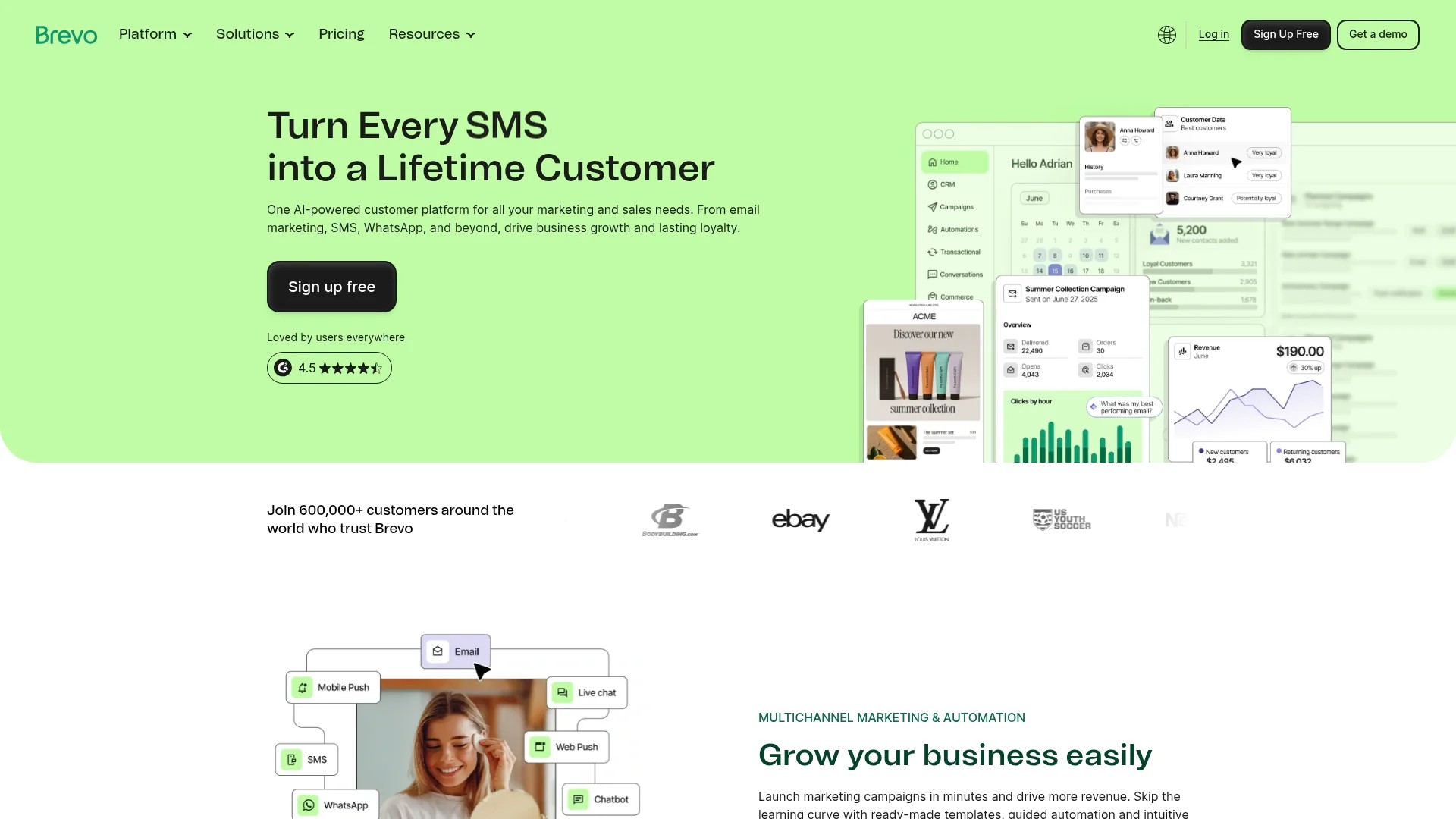
Brevo (formerly Sendinblue) charges by email sends rather than contact count, which makes it the most cost-effective Mailchimp alternative for brands holding large subscriber lists with mixed engagement levels.
Most email marketing platforms penalise you for keeping unengaged contacts in your database. Brevo does not. Its free plan allows unlimited contacts and 300 emails per day. That pricing model suits brands running re-engagement campaigns, seasonal D2C businesses with large dormant lists, or any operation where contact count varies significantly across the year.
Brevo's marketing automation covers the core ecommerce use cases: welcome sequences, abandoned cart flows, transactional email, and SMS alongside email on a shared platform. The built-in CRM is basic but functional, useful for brands that want contact management without paying for a separate tool.
Brevo Pricing
Brevo's free plan includes unlimited contacts and 300 emails per day (roughly 9,000 per month). Paid plans start at $9/month for 5,000 sends per month, scaling to $18/month for 20,000 and $25/month for 40,000. For a brand with 20,000 contacts but only mailing active segments, Brevo's send-based pricing beats Mailchimp's contact-based model significantly.
Brevo also includes transactional email via SMTP at no extra cost, which Mailchimp charges separately for. That alone saves meaningful money for ecommerce stores sending order confirmations and shipping notifications at volume.
- Best for: Brands with large contact lists, mixed engagement, and a need for both email and SMS on one platform.
- Standout feature: Send-based pricing model with unlimited contacts.
- Free plan: Yes, unlimited contacts / 300 emails per day.
- Drag-and-drop editor: Yes, solid with good template library.
Verdict: Brevo is an intelligent Mailchimp alternative for any brand where contact count and send volume diverge. The pricing model is genuinely different and genuinely cheaper for most ecommerce use cases.
4. ActiveCampaign: Best Mailchimp Alternative for Advanced Marketing Automation
ActiveCampaign is the strongest email marketing automation platform for ecommerce brands that need multi-step behavioural workflows beyond what Mailchimp, MailerLite, or Brevo can deliver, with a visual automation builder that handles complex conditional logic without requiring developer support.
Where Mailchimp automation is linear and limited, ActiveCampaign's is genuinely branching. You can build sequences that split on purchase history, email engagement, predicted behaviour, or CRM data, then re-merge those branches into a single touchpoint later. That is the kind of lifecycle logic that drives meaningful repeat purchase rates.
ActiveCampaign includes a built-in CRM, which puts it in a different category to pure email marketing platforms. For B2B ecommerce brands or any store with a meaningful sales component alongside self-serve ordering, that CRM depth adds real value. Deal tracking, pipeline visibility, and contact management all sit inside the same platform as the email marketing automation.
ActiveCampaign Pricing and Automation Depth
ActiveCampaign does not offer a free plan, which is its biggest drawback against Mailchimp alternatives like MailerLite or Brevo. Paid plans start at around $15/month for up to 1,000 contacts on the Starter tier. Marketing automation features are available on all paid tiers, though the more advanced CRM and sales automation sits behind higher pricing.
The automation builder alone justifies the price for brands ready to use it. If your current Mailchimp setup consists of a welcome email and a monthly newsletter, ActiveCampaign is overkill. But if you want abandoned cart sequences, post-purchase upsell flows, win-back campaigns, and behavioural segmentation all running simultaneously, this is where you go.
- Best for: Growing ecommerce brands with complex customer lifecycle needs and a willingness to invest in setup.
- Standout feature: Visual email automation builder with advanced conditional logic.
- Free plan: No. 14-day free trial available.
- Drag-and-drop editor: Yes, with strong template library.
Verdict: ActiveCampaign is the automation choice for brands that have outgrown lightweight Mailchimp alternatives. The learning curve is real, but the ceiling is high. Pair it with good segmentation and you have a retention machine. Our guide to email segmentation strategies that drive results covers exactly the kind of logic ActiveCampaign handles best.
5. Omnisend: Best Mailchimp Alternative for Ecommerce Email and SMS
Omnisend is built exclusively for ecommerce and combines email marketing, SMS, and push notifications in a single platform, with pre-built automation workflows for abandoned cart, welcome sequences, order confirmation, and browse abandonment that connect directly to Shopify and WooCommerce.
The pre-built workflow library is genuinely useful. Most platforms offer automation but leave the sequencing logic entirely to you. Omnisend ships with ecommerce-specific flows ready to activate, which compresses setup time considerably for brands switching from Mailchimp. That said, the real value is not the templates but the channel coordination: you can run an abandoned cart sequence that starts with an email, follows up with an SMS if unopened, and fires a push notification as a final touchpoint, all from a single workflow editor.
Omnisend's segmentation goes deeper than most Mailchimp alternatives in this price range. Segments update in real time based on purchase behaviour, campaign engagement, and web activity. The product picker inside the email editor pulls live catalogue data, so your emails can feature real-time stock and pricing without manual updates.
Omnisend Pricing
Omnisend's free plan includes up to 500 emails per month and 60 SMS messages. Paid plans start at $16/month for up to 6,000 emails and unlimited SMS credits vary by volume. The pricing is email-send-based rather than contact-based, which suits ecommerce brands actively managing large lists.
Omnisend consistently ranks as one of the better-value email marketing platforms for ecommerce specifically because the automation and channel breadth included from lower tiers would cost more on competing platforms. If SMS is part of your retention strategy alongside email, Omnisend bundles both cleanly.
- Best for: Ecommerce brands running email and SMS together across the customer lifecycle.
- Standout feature: Omnichannel automation combining email, SMS, and push in one workflow.
- Free plan: Yes, 500 emails/month.
- Drag-and-drop editor: Yes, with live product picker.
Verdict: Omnisend is the practical Mailchimp alternative for ecommerce brands that want SMS without the complexity of a separate platform. Strong automation, solid integrations, and pricing that holds up as you scale.
6. GetResponse: Best All-in-One Email Marketing Platform
GetResponse is an all-in-one email marketing platform that combines email campaigns, email automation, landing pages, webinar hosting, and paid ads management under a single subscription, making it the broadest Mailchimp alternative in terms of tool breadth.
Most ecommerce brands do not need webinars in their marketing stack. But for D2C brands doing product launches, live shopping events, or educational content alongside their email programme, GetResponse eliminates the cost of a separate webinar tool. That bundling is where it earns its "all-in-one" positioning honestly rather than aspirationally.
GetResponse's email automation covers the standard ecommerce flows: welcome sequences, abandoned cart, post-purchase, and win-back. The visual workflow builder is clean and capable. Segmentation is solid, though it does not reach Klaviyo's predictive depth or ActiveCampaign's conditional branching complexity.
GetResponse Pricing and Free Plan
GetResponse offers a free plan for up to 1,500 contacts with basic newsletter and landing page functionality. Paid plans start at $15/month for 1,000 contacts on the Email Marketing tier, which includes full email automation. The Max tier, which unlocks webinars and advanced features, sits at a higher price point.
The free plan is genuinely useful for ecommerce brands starting out. At 1,500 contacts with automation access, it beats Mailchimp's current 250-contact free plan and gives you more room to test the platform before committing to a paid tier.
- Best for: Brands wanting one subscription to cover email marketing, landing pages, and webinars.
- Standout feature: Webinar hosting and paid ads management built in.
- Free plan: Yes, up to 1,500 contacts.
- Drag-and-drop editor: Yes, with responsive templates.
Verdict: GetResponse is the right Mailchimp alternative for brands that want to consolidate tools and reduce subscription overhead. Not the deepest ecommerce automation, but the breadth of functionality per pound spent is competitive.
7. Moosend: Best Budget Mailchimp Alternative for Ecommerce
Moosend is one of the most affordable Mailchimp alternatives offering genuine ecommerce automation, with paid plans starting at $9/month for up to 500 contacts and automation features available from the entry-level tier rather than locked behind higher pricing.
The price point is the headline. But the depth surprises. Moosend's automation builder handles abandoned cart sequences, product recommendations, and weather-based personalisation, features you would expect to pay more for at this tier. The drag-and-drop email editor is competent, and the template library covers standard ecommerce use cases.
Moosend integrates with Shopify, WooCommerce, and Magento, though the integration is not as deep as Klaviyo or Omnisend. Real-time behavioural triggers work, but the predictive segmentation and lifetime value modelling are absent at this price point. For brands that need automation without Klaviyo's pricing, Moosend fills a real gap.
Moosend Pricing
Moosend does not offer a permanent free plan but provides a 30-day free trial with full feature access. Paid plans start at $9/month for 500 contacts and scale predictably: $16/month for 2,000 contacts and $32/month for 5,000. The pricing beats Mailchimp at every comparable tier and includes email automation that Mailchimp reserves for higher tiers.
- Best for: Budget-conscious ecommerce brands needing automation without enterprise pricing.
- Standout feature: Automation features at the lowest price point of any platform reviewed.
- Free plan: No permanent plan, but a 30-day trial.
- Drag-and-drop editor: Yes.
Verdict: Moosend is the underdog in this list and earns its place. If budget is the primary constraint and you still want functioning abandoned cart and product recommendation automation, Moosend is the honest answer.
8. Constant Contact: Best Mailchimp Alternative for Simplicity
Constant Contact is a beginner-friendly email marketing platform that prioritises simplicity over depth, making it the most appropriate Mailchimp alternative for small business owners who want a clean interface, reliable deliverability, and phone support without a steep learning curve.
It is not the most exciting option on this list. Constant Contact does not have Klaviyo's automation depth or Brevo's pricing model. But it does something well: it is very easy to use. The drag-and-drop editor is simple and fast, the template library is wide, and the platform's deliverability track record is solid.
Ecommerce integrations cover Shopify and WooCommerce with basic automation triggers. The abandoned cart feature exists but is more limited than Omnisend or Klaviyo. Segmentation is contact-list-based rather than behavioural, which caps how targeted your email programme can be.
Constant Contact Pricing
Constant Contact does not offer a free plan, which is a notable disadvantage against most Mailchimp alternatives reviewed here. Paid plans start at $12/month for up to 500 contacts on the Lite tier. The Standard tier, which includes email automation and better segmentation, starts at $35/month for 500 contacts.
That pricing gap between Lite and Standard is wide. At $35/month for 500 contacts on Standard, Constant Contact becomes harder to justify when ActiveCampaign, MailerLite, and Brevo all offer stronger automation for the same or less money at that list size.
- Best for: Small business owners who want phone support and a simple interface over depth.
- Standout feature: Extensive event management tools and reliable deliverability.
- Free plan: No.
- Drag-and-drop editor: Yes.
Verdict: Constant Contact makes sense for businesses that prioritise ease and support access. For ecommerce brands focused on automation and ROI, the pricing and feature ceiling make it hard to recommend over the other options in this guide.
9. Kit (Formerly ConvertKit): Best Mailchimp Alternative for Creators
Kit (formerly ConvertKit) is an email marketing platform designed for creators, newsletter publishers, and digital product sellers, with a free plan covering up to 10,000 subscribers and a subscriber-first approach that prioritises list quality over batch sending.
The free plan is the most generous contact allowance of any platform in this guide. Ten thousand subscribers with access to email broadcasts and basic automation. For a creator building an audience, that is a meaningful head start.
Kit's automation is tag-based rather than workflow-visual. You assign tags to subscribers based on their behaviour, then trigger sequences from those tags. It is elegant for content-driven businesses and newsletter-first brands. It is less intuitive for ecommerce brands used to flow-based automation builders like Klaviyo or Omnisend.
Kit Pricing and Ecommerce Fit
Kit's paid Creator plan starts at $25/month for up to 1,000 subscribers and includes automated sequences, visual automations, and paid newsletter subscriptions. The Creator Pro tier adds advanced deliverability reporting and newsletter referral tracking.
For ecommerce brands, Kit is a limited choice. It lacks native abandoned cart automation, product recommendation logic, and the kind of deep Shopify integration that Klaviyo or Omnisend offer. But for D2C brands built around content, editorial, or a strong newsletter audience, Kit's simplicity and creator tooling are genuinely valuable.
- Best for: Creators, educators, and newsletter-first D2C brands.
- Standout feature: 10,000-subscriber free plan and paid newsletter monetisation built in.
- Free plan: Yes, up to 10,000 subscribers.
- Drag-and-drop editor: Basic; text-first design philosophy.
Verdict: Kit is not the right Mailchimp alternative for most ecommerce stores. But if your brand sits at the intersection of content and commerce, with a newsletter at the centre of your acquisition strategy, it deserves serious consideration.
10. HubSpot: Best Mailchimp Alternative for All-in-One CRM and Email
HubSpot's free email marketing tool sits inside a complete CRM platform, making it the most appropriate Mailchimp alternative for ecommerce brands that want contact management, deal tracking, and email automation without paying for multiple separate tools.
The free CRM is genuinely free and genuinely capable. Contact records, company data, deal pipelines, and basic email marketing all available at no cost. For small D2C brands that also manage a B2B component, trade accounts, or wholesale relationships alongside their direct email programme, that CRM depth has no equivalent at this price point.
HubSpot's email marketing automation on free and starter tiers is more limited than ActiveCampaign or Klaviyo. You get basic workflows and conditional logic, but the advanced behavioural triggers and predictive segmentation require Marketing Hub Professional, which starts at $800/month. That gap is significant.
HubSpot Pricing and Ecommerce Relevance
HubSpot's free plan includes up to 2,000 email sends per month and basic CRM tools. The Starter tier starts at $15/month and increases email send limits and workflow capacity. The jump to Professional at $800/month is steep and takes HubSpot out of the running for most ecommerce brands as a pure email marketing platform.
Use HubSpot if CRM is the priority and email marketing is secondary. Use Klaviyo if email automation and ecommerce revenue are the priority. The two tools serve genuinely different primary use cases, despite both appearing in Mailchimp alternatives lists.
- Best for: Brands that need CRM-led contact management alongside their email programme.
- Standout feature: Full CRM, deal tracking, and contact management free of charge.
- Free plan: Yes, with CRM and basic email marketing.
- Drag-and-drop editor: Yes.
Verdict: HubSpot earns its place as a Mailchimp alternative for brands where CRM functionality justifies the ecosystem. Pure ecommerce email marketing is not its strength. Treat it as a CRM with email capability, not an email platform with CRM bolted on.
AWeber: Reliable Mailchimp Alternative for Small Business Email Marketing
AWeber is one of the longest-running email marketing platforms, with a free plan covering up to 500 subscribers and a simple, reliable drag-and-drop editor that suits small business owners who value stability and straightforward deliverability over advanced automation features.
AWeber does not try to be Klaviyo. That is both its weakness and its honesty. The platform's automation covers standard flows: welcome sequences, drip campaigns, and basic tagging. It integrates with Shopify and PayPal, which covers the core ecommerce touchpoints for small stores.
The drag-and-drop editor is functional rather than impressive. The template library is large. Customer support is consistently rated well, with phone and live chat available even on the free tier, which almost no other platform offers.
AWeber Pricing
AWeber's free plan covers 500 subscribers and 3,000 monthly sends with access to basic automation and the full template library. Paid plans start at $12.50/month for up to 500 subscribers with unlimited sends. At 5,000 subscribers the cost moves to $50/month, which becomes less competitive against MailerLite and Brevo at that list size.
- Best for: Small businesses and solopreneurs prioritising simplicity and reliable support.
- Standout feature: Phone and live chat support on the free plan.
- Free plan: Yes, 500 subscribers / 3,000 sends.
- Drag-and-drop editor: Yes, straightforward and reliable.
Verdict: AWeber is the safe, stable Mailchimp alternative for small businesses that do not need deep ecommerce automation. It will not transform your retention strategy, but it will send your emails reliably with decent support if things go wrong.
How to Choose the Right Mailchimp Alternative for Your Ecommerce Store
The right Mailchimp alternative for your ecommerce store depends on three variables: your current contact list size and growth trajectory, the automation depth your retention strategy requires, and whether ecommerce-specific features like abandoned cart recovery and product recommendations are central to your revenue model.
For most active ecommerce and D2C brands, the answer is Klaviyo. Not because of the brand name, but because the revenue data is clear. Retail and ecommerce companies achieve a 45:1 ROI from email marketing according to Klaviyo's ecommerce benchmarks, and that ROI is driven by exactly the kind of behavioural automation Klaviyo handles best. The platform migration is a one-time effort. The returns compound across every customer lifecycle touchpoint indefinitely.
For brands not yet ready for Klaviyo's pricing or complexity, MailerLite is the strongest free Mailchimp alternative. Its free plan covers 1,000 contacts, the automation is clean, and the pricing scales affordably. Brevo is the smarter choice once contact lists grow large but engagement drops, because its send-based pricing does not penalise you for holding a large database.
ActiveCampaign is the automation specialist for brands that need complex multi-step flows and CRM functionality in one place. Omnisend is the ecommerce-specific choice for brands combining email and SMS. And if you are a content-led D2C brand building around a newsletter, Kit is the honest recommendation over Mailchimp for that use case.
One practical step: before you migrate, run an audit of your current email programme. Identify which flows you have, which you do not, and what revenue is sitting untapped in sequences you have never built. That audit shapes which platform you actually need. Our email marketing audit and roadmap service does exactly that for ecommerce brands evaluating a platform switch.
And once you have chosen your platform, the goal is not just migration. It is making retention inevitable. Get the flows live, test them, optimise them, and build a customer lifecycle programme that compounds over time. That is where the 45:1 ROI lives. Not in the platform itself, but in how you use it.
Ready to move beyond Mailchimp? Start with our complete ecommerce email marketing guide for 2026 for the full strategic picture, then choose your platform accordingly.
.jpg)
.jpg)